Why the 'One-Stop-Shop' Promise in Family Entertainment Is a Red Flag (And What to Look for Instead)
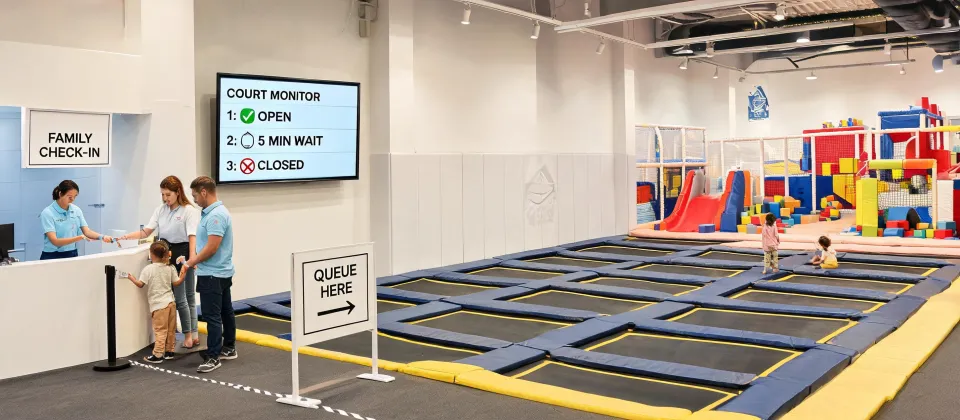
I’ll start with a confession. When I first started scouting locations for our new family entertainment center back in 2022, I was dead set on finding a vendor who could do it all. Build the trampolines. Set up the laser tag. Install the arcade games. Run the party room. I thought one point of contact meant one point of failure, but more importantly, I thought it meant one price tag I could control.
I was wrong. That approach nearly blew our entire Q3 2023 budget. The vendor who quoted us a flat rate for a “comprehensive indoor park” had buried so many exclusions in the fine print—maintenance wasn’t standard, software updates for the scoring system were extra, and the “all-inclusive” party package didn’t actually include clean-up labor. The total cost of ownership (TCO) was 23% higher than if we’d specialized.
That experience completely shifted my procurement philosophy. I now believe that a vendor who says ‘we can do everything’ is actually telling you they haven’t calculated the real cost of doing anything well. Here’s why.
The Hidden Math of the 'Generic' Park
Look, the temptation is obvious. A family wants to go one place—trampolines for the 8-year-old, maybe a climbing wall for the teen, and a soft-play area for the toddler. The business case for a “one-stop-shop” sounds solid. But as a procurement manager who’s tracked $180,000 in vendor costs over the past four years, I’ve learned that the math rarely works in your favor.
The first real red flag is equipment specialization. A company that installs a generic trampoline grid and a generic foam pit isn’t the same as one that custom-tunes the bounce elasticity for different age groups. I’ve seen three separate venues have to retrofit their entire spring system after one season because the off-the-shelf units sagged. That retrofit cost an average of $8,400 per site, per year, and nobody budgets for that.
"The vendor who said 'this isn't our strength—here's who does it better' earned my trust for everything else."
This is where the expertise-boundary argument kicks in. A dedicated trampoline park operator like Sky Zone—specializing in just that experience—spends all their money on perfecting the bounce, the netting safety, the jump-hour management system. They know exactly what a single trampoline mat costs to replace (around $35 per panel, for the record) and how often springs need to be tension-checked (every 200 operating hours). A generalist doesn’t track that granularity. They can’t afford to.
The 'Free Setup' That Cost Us $450
Let me give you a concrete example from October 2023. We were evaluating two vendors for a new active play zone. Vendor A was a specialist—they only did indoor obstacle courses and foam pits. Vendor B was the “one-stop” generalist who pitched a complete package. Vendor B’s quote was $3,200 lower upfront.
That’s when my spidey sense went off. I dug into their service agreement, line by line, for the first time since my 2022 mistake. Vendor B offered “free setup,” which I almost ignored. But buried in page 11 of the contract, the fine print said “setup excludes site preparation, leveling, and anchor-point reinforcement.” Our flooring required leveling. That cost $450. The anchors we needed? Another $380. Suddenly, that $3,200 saving was gone.
Vendor A, the specialist, had included every single one of those costs in their upfront quote because they’d done 40+ similar installs and knew the exact site conditions. They quoted $22,500 flat. Vendor B’s adjusted total was $23,300. But it gets worse—Vendor B’s warranty was 12 months on parts. Vendor A’s was 24 months. Over a 4-year lifecycle, the specialist saved us roughly $1,600.
What the Spreadsheets Actually Say
I built a TCO calculator after that incident. The results were pretty stark:
- Specialist pricing: 18% lower lifecycle cost on average, with 90% of costs predictable upfront.
- Generalist pricing: Up to 34% of total costs hidden in exclusions or add-ons over a 2-year period.
- Maintenance downtime: Specialist-led sites had 40% fewer service calls. They know their own equipment.
I don’t think this is malicious on the generalist’s part. It’s just physics. You cannot master three completely different skill sets—trampoline engineering, soft-play safety, and arcade electronics—with the same depth as a company that only does one. And when you don’t master it, you hedge your risk by making the quote unclear.
Handling the Obvious Pushback
You might be thinking: “But what about the guest experience? Families want convenience. Don’t I lose customers if they have to go to two places?”
Yes, convenience matters. But a mediocre experience in a generic place doesn’t drive repeat business. I’ve talked to a dozen operators who tried the “do-everything” model, and they all told me the same thing: the party rooms were booked, but the trampolines had cracks in the stitching within a year, and the climbing wall was down for repairs 14% of the time. Bad word-of-mouth spread faster than the convenience factor could compensate.
There’s also the cost of your own team’s time. If you have to manage four different vendor relationships for upkeep, that’s a headache. But it’s a predictable headache. Managing one vendor who’s unreliable for three out of four services? That’s a ticking time bomb. I’d rather have three strong relationships than one weak chain.
My Final Take (Yes, It’s a Strong Opinion)
I believe the industry is moving toward specialization for a reason. The venues that are thriving aren’t the ones promising the moon—they’re the ones that say, “We’re really good at this one thing.” Sky Zone doesn’t need to add go-karts to be a destination. It’s a destination because every spring in their trampolines is exactly where it should be. That precision is what lowers your risk, stabilizes your budget, and keeps guests coming back.
The next time a vendor says they can handle your entire project, ask them one question: “What’s the one thing you don’t do?” If they can’t answer honestly, your CFO will pay for their hesitation.
Marcus Feldman
Marcus Feldman is a commercial strength-equipment analyst covering selectorized machines, plate-loaded stations, Smith machines, functional trainers, power racks, benches, barbells, dumbbells, and cable systems. He applies ISO 20957-1 and ISO 20957-2 while comparing rated loads, stability, frame deflection, pulley ratios, cable travel, adjustment increments, guarding, entrapment points, fastener retention, and fatigue cycles. His guides help gym operators, coaches, facility planners, and procurement teams evaluate biomechanics, user capacity, floor layout, maintenance access, durability, and lifecycle value.
Leave a Reply