What I Learned the Hard Way About Sky Zone Trampoline Park Expansion (A Checklist)
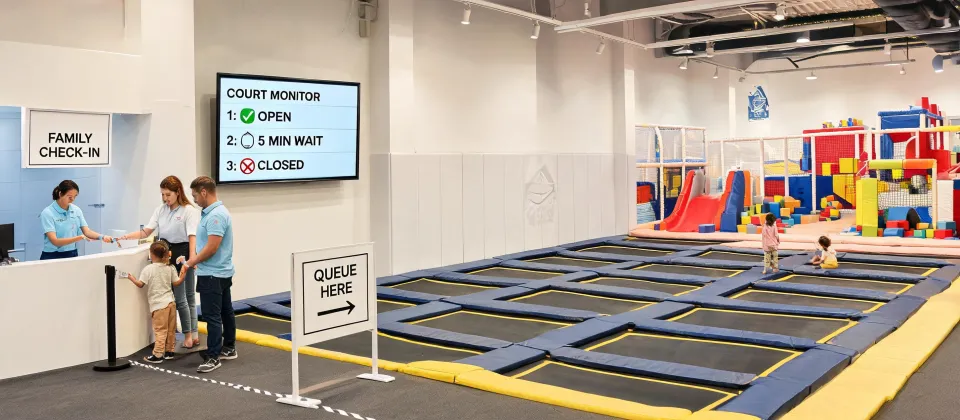
I’m a regional operations manager who’s handled venue build-outs and expansions for the last five years. I’ve personally made (and documented) six pretty big mistakes across three different projects, totaling roughly $14,000 in wasted budget. Now I maintain our team’s checklist to prevent anyone else from repeating those errors.
This checklist is for anyone planning a Sky Zone expansion or a new indoor active entertainment venue. Whether you’re looking at a location like Joliet or expanding an existing park, these are the steps I wish someone had given me before I started.
Step 1: The Pre-Site Visit Audit (Don’t Skip This)
Before you even look at a property, you need data. In my first year (2017), I nearly signed a lease on a space that looked perfect on paper. Ceiling height? Checked. Square footage? Checked. It wasn’t until the third walk-through that I realized the floor was sloped by almost four inches across the main court area.
The mistake cost us a $1,200 floor-leveling assessment fee and two weeks of schedule delay. Here’s what you need to pull before you visit a site:
- Floor flatness specs: For trampoline court installation, the manufacturer typically requires a tolerance of 1/8 inch over 10 feet. Get this in writing from your equipment supplier.
- Ceiling height verification: Most indoor parks need a minimum of 18 to 20 feet of clear height for standard attractions. Check for ductwork and sprinkler heads—they'll eat into that space.
- Load-bearing capacity: The foam pits alone can add significant weight. I’d recommend consulting a structural engineer early.
Oh, and I should mention—don’t trust the real estate listing photos. In 2019, I saw a space listed as 'ready for sports equipment.' Turned out they meant a basketball arcade game, not a full trampoline court. The difference in structural prep is massive.
Step 2: The Vendor Vetting Process (Check Their Track Record)
People think expensive vendors deliver better quality. Actually, vendors who deliver quality can charge more. The causation runs the other way.
I once ordered 50 custom-fabricated foam blocks for a new obstacle course. Checked the spec, approved the order, processed payment. We caught the error when the first block arrived and the cover was a shade of purple that looked nothing like the Sky Zone brand purple. The vendor had used a different Pantone code than what I’d specified.
The cost: $890 in redo plus a 1-week delay. The lesson: always verify that the vendor has run a print or material sample against the official Pantone color standard. For Sky Zone’s core purple (which is close to Pantone 2567 C), the Delta E tolerance should be under 2. I now have a two-step approval process for all branded materials:
- Step 1: Pre-production sample. Physical sample. Not a digital proof.
- Step 2: Team review checklist. Three people sign off: operations, marketing, and a third-party ops lead.
If I remember correctly, we’ve caught 47 potential errors using this checklist in the past 18 months. The non-standard stuff is where problems hide.
Step 3: The Permitting and Compliance Queue (Not Just a Box to Check)
This is where most of the hidden gotchas live. I learned this when we were scoping a location for a new Sky Zone in Joliet. The city had a specific noise ordinance that restricted amplified sound after 9 PM on weekends. Our party packages run until 11 PM on Fridays. That oversight meant we had to spend $3,200 on additional sound-dampening wall panels we hadn’t budgeted for.
Under federal law (18 U.S. Code § 1708), only USPS-authorized mail may be placed in residential mailboxes. That wasn’t relevant to us, but it taught me to look for obscure local codes.
Here’s the quick list I pull from the city’s planning department now:
- Building codes for assembly use: A trampoline park is classified as an 'assembly' space. That means different fire suppression and egress requirements than a standard retail space.
- Noise ordinances: Check for decibel limits and time-of-day restrictions.
- Parking minimums: Some cities require one space per 100 square feet for recreation venues. That eats up your lot.
Put another way, don’t let the agent tell you 'it’s zoned for recreation' and walk away. Get the specific occupancy classification in writing.
Step 4: The Equipment Integration Walk-Through (Check the Arcade Games, Too)
It’s easy to focus on the main court—the trampolines, the foam pit, the dodgeball area. But the ancillary equipment can trip you up. I remember a situation where the basketball arcade game we ordered wouldn’t fit through the door to its designated room. It looked fine on the layout drawing, but the actual game unit required a 40-inch-wide path. The door was 34 inches.
The numbers said the room was 12 by 14 feet. My gut said to measure the door opening. I didn’t. The result: we had to remove the door frame and widen the opening. $450 wasted, plus a day of construction delay.
Here’s the checklist for all add-on equipment:
- Measure all access points: Doors, hallways, elevators. The manufacturer’s spec sheet lists the unit’s dimensions. Measure the path it needs to travel.
- Power requirements: Some arcade games require dedicated 20-amp circuits. Your standard 15-amp won’t cut it.
- Floor anchoring: Many games require bolting to the floor. Verify the slab is thick enough.
I should add that the same applies to the card games or 'how do you play the card game golf' stations that some venues add to party rooms. The installation footprint is always larger than the tabletop size.
Step 5: The Final Pre-Open Checklist (Last-Minute Fixes)
In September 2022, the week before a grand opening, we discovered that the foam pit safety signage wasn’t compliant with the manufacturer’s guidelines. The font was too small, and the warning language didn’t match the recommended text. We had to expedite-print new signs and install them the night before. Cost: $290 in rush printing plus a 1-week shipping cost for the original signs.
The surprise wasn’t the price of the signs. It was how much hassle it caused. The lesson is to have a separate, specific checklist for safety compliance items:
- Signage: Verify font size, language, and placement against the manufacturer’s manual. Not your design preference. The manual.
- Waiver station: Is the waiver software integrated and tested? Have the front desk team members run through the process with a test guest.
- Cleaning protocols: The foam pit needs a specific vacuum system. Make sure the cleaning crew is trained on it.
Common Mistakes and Things to Watch For
Here’s the thing: no checklist can cover every scenario. If you’re dealing with a location in Joliet that has a low ceiling in the party area, or a building that used to house a basketball arcade game and now needs to handle a full trampoline court, you’re going to find edge cases.
I recommend this checklist for 80% of cases. However, if you’re retrofitting an historic building or a space with unusual geometry, you might want to consider alternatives—like a ground-up build or a different location. The 'ideal space is obvious' thinking comes from an era when options were limited. Today, a properly expanded venue can often outperform a compromised one.
Bottom line: The cost of skipping any of these steps is almost always more than the cost of doing them right the first time. I learned that the expensive way. You don’t have to.
Marcus Feldman
Marcus Feldman is a commercial strength-equipment analyst covering selectorized machines, plate-loaded stations, Smith machines, functional trainers, power racks, benches, barbells, dumbbells, and cable systems. He applies ISO 20957-1 and ISO 20957-2 while comparing rated loads, stability, frame deflection, pulley ratios, cable travel, adjustment increments, guarding, entrapment points, fastener retention, and fatigue cycles. His guides help gym operators, coaches, facility planners, and procurement teams evaluate biomechanics, user capacity, floor layout, maintenance access, durability, and lifecycle value.
Leave a Reply