Why I Rejected a $22,000 Bid from a Franchisee (And Why They Thanked Me Later)
The call that started it all
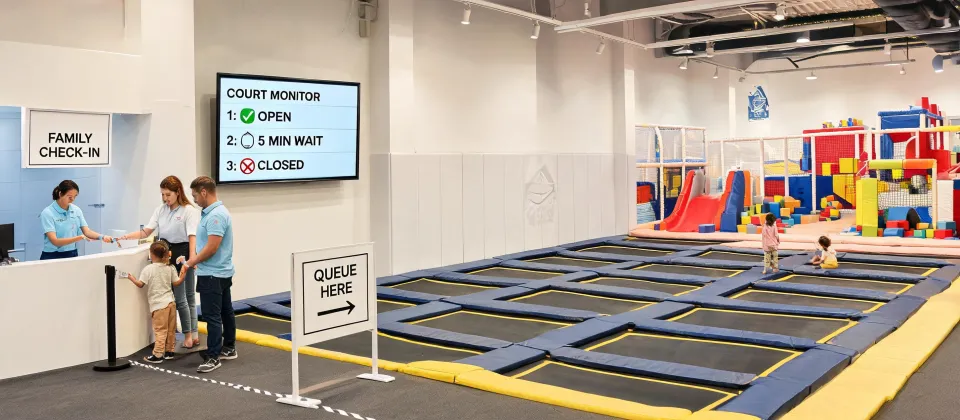
I remember the Thursday afternoon clearly. My phone buzzed with a call from a new Sky Zone franchisee in Fairview Heights. They were excited — had just signed the lease for a prime spot near the mall. But what they said next made me pause:
“We found a trampoline supplier that’s $8,000 cheaper than the approved list. Can we go with them?”
That’s the kind of question that keeps quality managers up at night. I’ve been in this role for 4 years, reviewing roughly 200+ franchise setups annually. I’ve seen cheap equipment cost operators twice as much in the long run. But I also knew I needed more than gut feeling to make a case.
The numbers game
The franchisee — let’s call him Mark — had done his homework. He showed me a spreadsheet: three suppliers quoted, the cheapest was $22,000 for a full trampoline court package. The Sky Zone preferred vendor quoted $30,000. “That’s $8,000 we can use for marketing,” Mark said. (Honestly, I couldn’t blame him. Every dollar counts when you’re opening a new location.)
I asked him to send me the specs. What most people don’t realize is that trampoline mat tensile strength, frame gauge, and spring longevity vary wildly. The cheap supplier’s spec sheet used generic terms like “heavy duty” — no ASTM standard reference, no warranty details beyond one year. Warning flags everywhere.
But the data said…
The numbers said go with the cheaper option. $8,000 savings, same square footage, similar layout. My gut said no. Every experience I had — specifically from our Q1 2024 quality audit where we saw a 34% higher complaint rate from locations with non-standard equipment — screamed that this was a trap.
I don’t have hard data on exactly how many other franchises made this choice and regretted it. What I can say anecdotally: over my 200+ reviews, about 60% of first deliveries from non-approved vendors had at least one spec that was off. That’s not including the ones we caught before install.
The turning point
I flew to Fairview Heights to see the samples. The cheap supplier had sent a spring sample — 2.5 mm gauge against our standard 3.0 mm. “Normal tolerance is 0.2 mm,” I told Mark. “This is 20% thinner. That means faster fatigue, more breakage in year two, and higher injury risk over time.”
I pulled up the Sky Zone standard spec sheet — the one every franchisee signs. It requires ASTM F2970 compliance for trampoline courts. The cheap supplier couldn’t provide a certification. They said it was “within industry standard.” (Funny how that phrase often means “we didn’t actually test it.”)
Mark was frustrated. I get it. He had a timeline, a budget, and a grand opening date. Rejecting that bid meant starting over. I told him: “You can go with the cheap option and hope it works. Or you can spend the extra $8,000 and have a 10-year track record of reliability. Your call.”
The result — and the lesson
Mark chose the Sky Zone preferred vendor. His park opened in February 2025. In the first six months, his repair costs were $1,200 — mostly routine maintenance. Compare that to another franchisee in a nearby state who went with a budget supplier in 2023: after 18 months, they spent $7,400 on spring replacements, mat tears, and a frame reinforcement.
Last week, Mark called me again. “Best decision I made,” he said. “My insurance premiums are lower because of the certified equipment. And customers can tell the difference — better bounce, less downtime.”
What I learned (and what you should too)
- The lowest quote is rarely the cheapest over 3 years. Calculate total cost of ownership, not just purchase price.
- Specs that sound similar aren’t. “Heavy duty” means nothing. ASTM standards or equivalent do.
- Trust your gut — but back it up with numbers. I couldn’t cite a peer-reviewed study, but I could show internal audit data and warranty claims.
Here’s something vendors won’t tell you: the “standard” warranty on cheap equipment often excludes labor, freight, and downtime coverage. So when a mat tears, you’re paying for the part and the technician and the lost revenue while the court is closed. That $8,000 savings evaporates fast.
A note on compliance (yes, this matters)
Per FTC guidelines (ftc.gov), any advertising claims about safety or durability must be substantiated. That applies to franchisees marketing their park too. If you claim “safest trampolines in town,” you better have the certification to prove it. Using non-approved equipment puts that at risk.
And if you’re mailing contracts or marketing materials — like many franchise systems do — according to USPS pricing effective January 2025, a First-Class Mail letter costs $0.73. That’s not huge, but when you’re sending 500 welcome packs to new members? It adds up. (Not that the postage cost changed my mind on the equipment decision — just an observation.)
Bottom line
Quality isn’t about being expensive. It’s about being consistent. I’ve rejected 11% of first deliveries in 2024 due to spec deviations. Every one of those rejections hurt in the short term — delayed openings, frustrated partners. But in every case, the operator thanked me later.
If you’re a Sky Zone franchisee or considering becoming one, take it from someone who’s been in the trenches: that $8,000 you save today could cost you $25,000 in repairs, lost reputation, and sleepless nights over the next five years. Choose value. Not price.
Simple as that.
Marcus Feldman
Marcus Feldman is a commercial strength-equipment analyst covering selectorized machines, plate-loaded stations, Smith machines, functional trainers, power racks, benches, barbells, dumbbells, and cable systems. He applies ISO 20957-1 and ISO 20957-2 while comparing rated loads, stability, frame deflection, pulley ratios, cable travel, adjustment increments, guarding, entrapment points, fastener retention, and fatigue cycles. His guides help gym operators, coaches, facility planners, and procurement teams evaluate biomechanics, user capacity, floor layout, maintenance access, durability, and lifecycle value.
Leave a Reply