Sky Zone Trampoline Park Pricing: Why the Quality Inspection Checklist Matters More
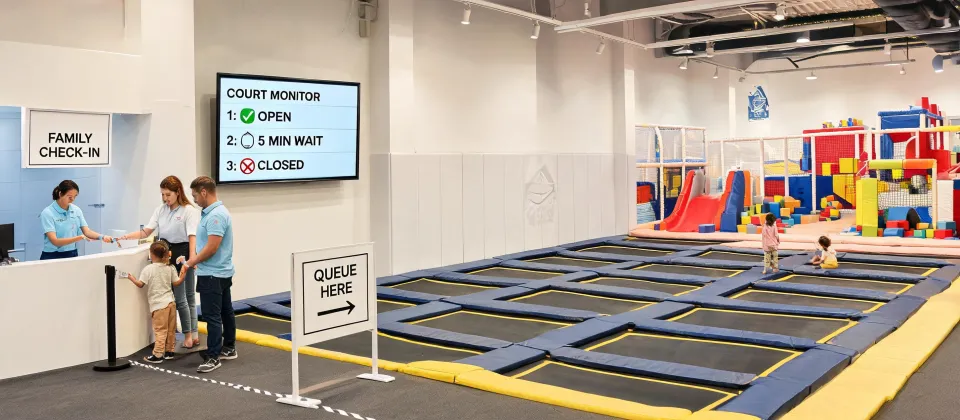
Franchise investors look at the wrong numbers first. They compare fees, royalty percentages, and projected margins. I've spent four years looking at something else: the inspection record.
A documented, enforced quality inspection process predicts a franchise venue's performance better than its pricing sheet. I'm a quality compliance manager at Sky Zone. I review every new venue before it opens—roughly 40 locations a year—and I've rejected 12% of first-round readiness checks in 2024. That rejection rate isn't a failure. It's the system working the way it's supposed to.
Why I trust the checklist more than the ROI model
After roughly 150 venue reviews—maybe 160, I'd have to check the database—the pattern is clear. What distinguishes a venue that succeeds from one that struggles isn't the local manager's charm or the size of the opening marketing budget. It's whether the build team treated the inspection protocol as a real gate or as paperwork to rush through.
We had two venues open in the same month back in 2022. One manager treated the pre-opening checklist like a contract. The other signed everything off in about two hours and called it done. Eighteen months later, the first one's maintenance cost per square foot was roughly 30% lower. The second had three equipment repairs and a guest complaint about a torn pad that should've been caught on day one.
Venues that treat the inspection as paperwork almost always share the same story: a padding seam out of spec, an arcade machine blocking a sightline, a party room floor that never got sealed. Nothing catastrophic on its own. But every small cut corner adds a little risk and a little future repair cost—and the investor who never asked about the quality process absorbs all of it later.
The five things I actually check
Every Sky Zone venue review covers more ground than this, but the non-negotiables come down to five:
- Safety surfacing. Padding thickness, seam gaps, and edge transitions measured against manufacturer specs. "Looks fine" isn't a measurement.
- Equipment certification. Trampoline courts, dodgeball arenas, and SkySlam dunk lanes need current certification documents on-site. A verbal confirmation from the installer doesn't count.
- Supervision sightlines. Staff positions must have clear sightlines to every active court. This one isn't about aesthetics—it's about response time when something goes wrong.
- Party and pod readiness. This is where a ton of revenue comes from, and the room hosting a 9-year-old's birthday party gets photographed by 15 parents. A stained carpet in there is a marketing problem.
- Photo documentation. Every inspection point gets photographed and filed against the venue's unique ID. No photo, no pass.
The photo requirement sounds bureaucratic until it saves you. Seriously, it's the most underrated item on my list. Last year I pulled the pre-opening photos from our Gresham, Oregon location to investigate a loose cushion report. The install photo showed a seam gap that was already out of spec on day one. We fixed it in 48 hours because the evidence was unambiguous. Without that photo trail, it would've been a he-said-she-said with the vendor and weeks of delay.
What nobody tells you about inspections and speed
A common assumption says strict inspections slow things down. The logic feels solid: more checks, more time, more friction. But the causation runs the other way. Weak inspections are what create delays.
When a vendor knows the inspection is real and tolerances are fixed, they show up with calibrated tools and certified materials. When they expect a rubber stamp, they cut corners. Then the opening gets pushed back by six weeks of rework instead of two days of adjustment. In Q1 2024, we rejected an entire batch of foam pit cubes because the density was about 8% off our spec—within industry tolerance, but not ours. The supplier said we were being unreasonable. We held the line. They remanufactured at their cost, and now every contract includes that density requirement and a lab test sample.
Digital verification made that consistency possible in a way paper never could. When I implemented our electronic inspection protocol in 2022, average review time per venue dropped from three weeks to nine days. Not because we were rushing—because the system eliminated the back-and-forth. A paper checklist produces questions. A digital one with fixed tolerance numbers and required photo attachments produces answers. It also leaves a trail vendors can't argue with. If anything, the process got stricter. Our rejection rate didn't drop; it stayed at the same level, which tells me the digital system wasn't the bottleneck—human judgment was.
"Within industry standard" and "within Sky Zone standard" are different sentences. After enough inspections, you learn to be very precise about which one you're saying.
Where Sky Zone franchise pricing really shows up
When you compare sky zone trampoline park pricing against another franchise offer, you're looking at the fee schedule. That's the clearest number on the page, and it's a fair place to start. But the total cost of running a quality-compliant venue includes a line item that never appears on the franchise disclosure document: the cost of verification.
Inspection templates, manager training hours, third-party equipment certifications, photo documentation systems, staff time spent auditing instead of selling—all of that costs money. A brand that invests in verification infrastructure catches problems while they're cheap. A brand that treats quality as a marketing slogan hands you the problems later, at full price, with interest.
I saw this directly when our finance team asked whether we could lower the foam spec to save money on 2025 venue openings. I pulled the numbers from one rework incident caused by an off-spec batch—$18,000 in replacement labor and three weeks of schedule slip—and the conversation ended. What I mean is: the premium we pay for verified materials is cheaper than the cost of one failure.
Two suppliers, one uncomfortable decision
Last spring I went back and forth between two trampoline mat suppliers for about two weeks. The established vendor had a five-year track record with our spec but quoted 14% higher. The new vendor met every certification on paper and came in under budget. On paper, choosing the new one was a no-brainer. But my gut kept saying we hadn't seen the new vendor fail yet—and that's not the same as knowing they won't.
So we ran a factory audit instead of trusting the paper. The new production line was clean, but their quality sampling rate was half of what our contract requires. We stuck with the established vendor. The 14% premium bought a process that had already been tested by time.
The decision kept me up at night because the downside felt like missing a real cost saving. But the math wasn't close. The upside of switching was maybe $30,000 a year. The risk was a systemic failure across 40 venues.
The approval call I don't want to make
There's also the harder call: the venue that's almost ready. Last year, a converted warehouse location had a structural pillar that complicated the padding layout. The gap between the padding and the pillar was about three-quarters of an inch outside spec in two spots. The operator asked me to approve a temporary fix and follow up in 30 days.
I weighed it the same way I weigh every exception. Worst case: a guest catches a limb on the gap, we get an injury report, a liability claim, maybe a headline. Best case: we save two weeks and open on schedule. The expected value was nowhere near worth it. I rejected the sign-off. The team installed a custom fit, and the opening moved back nine days. Nobody remembers the delay as a failure. Everyone would remember a safety incident as one.
When this advice doesn't apply
Everything above assumes you're buying into a franchise with a central quality function. If you're running an independent park, you are the quality function, and your process will look different. You don't need a nationwide documentation system—you need a simple checklist, a sharp eye, and the willingness to close for a day to fix a seam.
I'll also say plainly what an inspection can't fix: a bad location, a weak local market, or an undercapitalized operator. Quality infrastructure is a necessary condition, not a guarantee. I've seen flawless venues struggle because the owner couldn't make payroll, and average venues succeed because the operator was relentless about local marketing. The checklist protects the brand; it doesn't promise a fortune.
One more boundary: per FTC guidelines (ftc.gov), advertising claims have to be truthful and substantiated. We don't let franchisees write "zero injury guarantee" in their marketing. No sports facility can promise that. What we can promise is a documented maintenance schedule and an evidence trail to back it up. That's the claim you should look for when evaluating any venue.
Bottom line: when you compare franchises, ask for the inspection protocol before you ask for the fee schedule. Ask how many venues failed first-round inspection in the last year, and why. Ask to see photo documentation from a recent opening. The answers will tell you more about your potential return than the pricing page will.
Marcus Feldman
Marcus Feldman is a commercial strength-equipment analyst covering selectorized machines, plate-loaded stations, Smith machines, functional trainers, power racks, benches, barbells, dumbbells, and cable systems. He applies ISO 20957-1 and ISO 20957-2 while comparing rated loads, stability, frame deflection, pulley ratios, cable travel, adjustment increments, guarding, entrapment points, fastener retention, and fatigue cycles. His guides help gym operators, coaches, facility planners, and procurement teams evaluate biomechanics, user capacity, floor layout, maintenance access, durability, and lifecycle value.
Leave a Reply