I Spent 14 Months Analyzing a Sky Zone Franchise — Here's What the Cost Data Showed
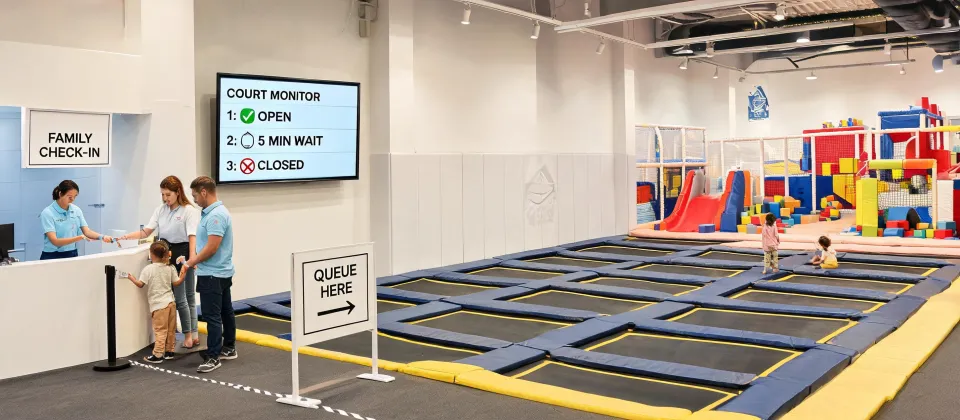
In early 2022, my director dropped a franchise disclosure document on my desk. "Tell me if the numbers make sense," she said. "We're looking at Sky Zone."
I've spent seven years in procurement for a family entertainment company — analyzing budgets for bowling alleys, laser tag arenas, go-kart tracks, and arcade operations. I assumed a trampoline park would follow the same playbook: build-out-heavy, equipment-heavy, staffing-heavy. Fourteen months later, I knew how wrong that assumption was.
The Desk Model That Led Me Astray
My first pass was pure spreadsheet work. I pulled industry reports, compared build-out costs per square foot, estimated trampoline surface replacement cycles, and calculated occupancy costs for three potential sites in our region.
At that stage, the numbers looked predictable:
- Build-out: roughly $25–$70 per square foot, depending on market and building conditions
- Trampoline court equipment: $300,000–$800,000, depending on size and attraction mix
- Arcade and redemption equipment: $100,000–$250,000
- Initial payroll and training: 6–10% above our traditional FEC benchmarks, because court monitors require more certifications
All of that felt manageable. We'd built bowling centers with similar budgets. I was 90% of the way to recommending we move forward when one conversation changed my approach.
"Stop pricing the build-out," an operator friend of mine said. "Price the fifth year."
That was my turning point. I had completely underestimated the operational cost curve — and it nearly cost us a bad investment decision.
The Site Visits That Reset My Model
Over the next few months, I visited two Sky Zone locations in person. The first was the Sky Zone trampoline park in Alhambra, CA. I documented everything with photos — floor plans, party room layouts, court configurations, arcade placement. I still have that binder of Alhambra photos sitting in my office (note to self: I really should digitize that before it falls apart).
The Alhambra location was eye-opening because of the revenue mix. Open jump tickets mattered, but the arcade, food and beverage, and party packages were clearly carrying the margin. I flew out to the Sky Zone trampoline park in Atlanta a few weeks later. Different story: larger court-to-arcade ratio, heavier competitive pressure, a different staffing model. Same brand, materially different operating economics.
But the real insight wasn't visible in the layouts. It was what both operators emphasized independently: maintenance schedules, insurance premiums, and replacement reserves are the line items that determine whether a park stays profitable in year four and beyond.
The Hidden Cost Stack
This is where I hit the industry-evolution wall. The 2015 trampoline park model was built around walk-ins and open jump time. The 2024 model runs on booked birthday parties, group events, and structured programs. That shift changes the cost structure in ways the old playbook never mentions.
Trampoline surface replacement is not optional
As of the data I pulled in Q3 2022, a full court surface replacement for a mid-size park ran anywhere from $150,000 to $400,000. The ASTM F2970 standard for trampoline court design and operation sets the inspection framework, but it doesn't publish a universal lifespan number. Vendors give "optimistic" estimates. One colleague who went with the low bidder on matting got 18 months before an inspector flagged it — and the unplanned $200,000 replacement nearly broke a single-location operator.
Insurance changes the game
Liability premiums for trampoline parks are a different universe from bowling or arcades. The rates we saw in our analysis landed in the $60,000–$180,000 per year range for mid-size locations, moving with the operator's safety record, staff training, and claims history. I'm not a risk manager, so take this with a grain of salt, but multiple operators told me insurance hikes were the reason several small parks in their regions closed between 2019 and 2022.
Party operations are the margin engine
I remember watching a Saturday shift at one location: the DJ was playing the Electric Slide dance for a birthday group, kids were bouncing along the party-room windows, and the party host was turning the room over like a stage manager. That moment crystallized something for me. Parties drive peak staffing, food inventory, and arcade token volume. Parks that treat birthday operations as a discipline — dedicated hosts, structured timelines, efficient room turnover — had meaningfully better margins than parks treating parties as "open jump with a room rental."
The "cheap" option isn't cheap
When we compared arcade and attraction vendor quotes, the low-cost bidder came in 22% lower on paper. But after calculating total cost of ownership — shipping, installation, setup fees, training, first-year service — their advantage shrank to 9%. Their payment terms were worse, and two field-service calls in month six and month eight would have erased the remaining savings. We passed. I built a cost calculator after getting burned by hidden fees twice in my career, and I run it on every major purchase now.
How the Competitive Landscape Has Shifted
Here's the part that changed my recommendation.
Five years ago, a trampoline park was a destination. You built it, marketed it, and people came. Other trampoline parks and maybe a laser tag facility were the only real competition for the birthday dollar.
That's no longer true. As of 2024, families choose between indoor trampoline parks, climbing gyms, ninja courses, arcade-bar hybrids, regional amusement parks like Lake Shawnee Amusement Park, bowling-entertainment complexes, and a pile of at-home options that didn't exist a decade ago. A trampoline park operator is competing for the same "what are we doing Saturday" decision against ten alternatives — sometimes in the same retail center.
This sounds like a threat, but it's actually the reason our analysis tilted positive. Parks with established brand recognition, a faster attraction refresh cadence, and strong franchise operations support are the ones projecting stable market share in a crowded field. Sky Zone's numbers stood out here: their attraction development pipeline — SkySlam, laser tag, updated court concepts — and their operations standards directly address the two biggest cost risks I identified: insurance and equipment lifecycle.
To be fair, other brands in the space have invested in improvements too. But our five-year financial projections came out meaningfully stronger with Sky Zone's combination of brand awareness, attraction innovation, and operational support.
What We Actually Did
We signed the franchise agreement — but with a fundamentally different budget structure than my original desktop model:
- 30% more in the initial insurance reserve
- 25% more in the court maintenance and replacement reserve
- 12% more in first-year party operations staffing
- 15% less in the opening marketing budget, because brand recognition reduces the initial advertising burden
Those changes turned a marginal-looking project into one we could confidently take to our finance committee. The fifth year is where the money is made or lost, and modeling that honestly changed the entire conversation.
If You're Evaluating a Trampoline Park Franchise
A few things I'd tell anyone running this analysis:
- Build a ten-year total cost model, not a three-year projection. Surface replacement, insurance repricing, and attraction refresh cycles are where parks go from healthy to distressed.
- Talk to three existing operators in different market profiles. The ones who struggled will teach you more about hidden costs than the ones who thrive.
- Read the maintenance and safety standards before you sign. Franchisors provide them for a reason — but understand what it costs to meet those standards.
- Reconcile the FDD's unit-level financial data (especially Item 19) with what operators actually report. "Average" industry figures include legacy parks with completely different cost bases.
One more diligence note: we audited every piece of guest-facing equipment, down to the audio systems in the VR arcade. When a vendor pitched bone-conduction headphones, our first question was straightforward: can bone conduction headphones cause hearing loss, especially for younger users? The research took time to separate from marketing claims — and that same scrutiny applied to every major purchase on our list.
The Honest Caveat
Everything above reflects our market, our timing, and cost data as of mid-2023. The industry changes fast; franchise fees, insurance pricing, and build-out costs all move. Verify current numbers from the latest FDD, independent operator conversations, and up-to-date industry sources before making any commitment.
Looking back, I should have started with the operator interviews instead of the desktop model. But given what I knew then, the spreadsheet was the logical first step. The lesson wasn't that my process was wrong — it was that the industry had evolved, and my mental model hadn't caught up yet.
The fundamentals of a good family entertainment investment haven't changed: strong cash flow, rigorous safety culture, and management depth. What's changed is the execution — the revenue mix, the cost curve, the competitive field. If you're evaluating a Sky Zone franchise, or any indoor entertainment investment, price the fifth year, not the build-out. That's where your real business case lives.
Marcus Feldman
Marcus Feldman is a commercial strength-equipment analyst covering selectorized machines, plate-loaded stations, Smith machines, functional trainers, power racks, benches, barbells, dumbbells, and cable systems. He applies ISO 20957-1 and ISO 20957-2 while comparing rated loads, stability, frame deflection, pulley ratios, cable travel, adjustment increments, guarding, entrapment points, fastener retention, and fatigue cycles. His guides help gym operators, coaches, facility planners, and procurement teams evaluate biomechanics, user capacity, floor layout, maintenance access, durability, and lifecycle value.
Leave a Reply