Opening a Trampoline Park: When Sky Zone Makes Sense (and When It Doesn't)
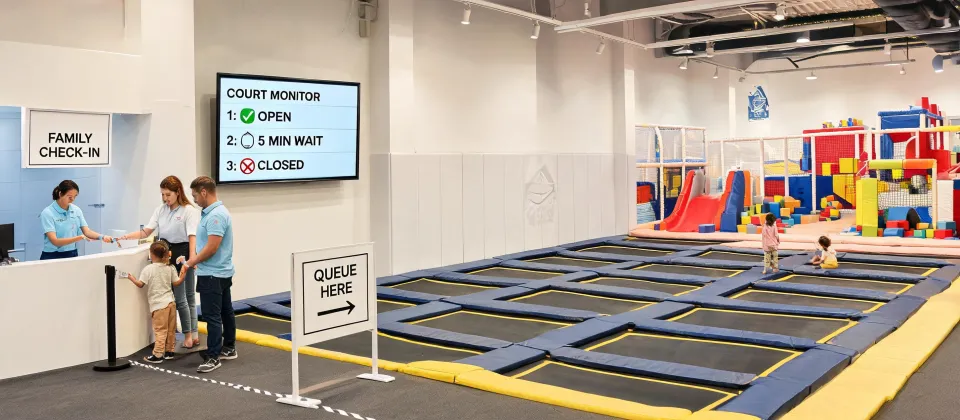
I'm a project coordinator at a commercial real estate advisory firm. I've handled 40+ rush venue openings in 8 years—including a Houston project in 2024 that went from empty shell to open door in 72 days. If there's one question I hear more than any other from clients, it's this:
Should we open a Sky Zone trampoline park, or go independent?
The honest answer: it depends. I don't trust consultants who give a universal recommendation on this, because the right choice changes dramatically based on your circumstances. The three variables that matter most are your time pressure, your operating experience, and how much risk you can absorb. Those three things sort every project I've worked on into one of three scenarios.
Scenario 1: You're a Property Owner With a Deadline
Say you own a 35,000-square-foot space in a mall or retail center. It's been vacant for six months. You're losing rent every month—and if your anchor lease has a co-tenancy clause, that vacancy can trigger a lease breach bigger than the rent loss.
This is the scenario where timing is the whole game. In March 2024, I had a client in Houston in exactly this position. The co-tenancy deadline was 90 days out. An independent operator came in with a lower rent offer—about 15% below what Sky Zone proposed. But he'd never built a trampoline park before. He estimated six months to open. After asking about his design approvals and equipment sourcing, my estimate was nine. That wasn't just a delay. Missing the deadline carried a $240,000 penalty clause.
We signed Sky Zone instead. Their build-out team had a system, the equipment specs were pre-approved, and 72 days later—18 days before the deadline—that Sky Zone trampoline park in Houston opened its doors. The rent was higher, roughly $15,000 more over the first quarter. But the independent option's 3-month delay risk alone was worth about $80,000 in vacancy and penalty exposure. The franchise premium paid for itself several times over, just by being faster.
If a clock is attached to your space decision, time-to-open is part of the price. Compare that, not just dollars per square foot.
Scenario 2: You're a First-Time Operator With a Budget
Let's say you've raised $1.5 million and want to open a trampoline park. The franchise fee feels steep, and royalties mean giving up a slice of every month's revenue. Going independent looks like an easy way to save 8-10% off the top.
It's tempting to think that. I did, once. I only changed my mind after watching a client try it and nearly lose everything.
In 2023, a client of mine—first-time operator, smart guy, ran the numbers himself—decided to go independent and "save" about $200,000 in franchise costs. He found trampolines at a discount from a trade show contact. He hired a local designer who'd never worked on a trampoline park. He wrote his own safety manual.
The savings didn't survive contact with reality. The designer's layout didn't match what the safety certification body required, so the trampoline zones had to be reconfigured after install—$40,000. The equipment arrived three weeks late, and without franchise leverage, the manufacturer required full payment upfront. He opened in 14 months, not 8. He was $130,000 over budget. Two years later, the park is finally breaking even. He tells other first-timers, "The franchise fee would've been the cheapest part of my education."
What a franchise actually sells you isn't the logo. It's the 500-page operations manual, a certification process that's already been passed dozens of times, a national booking platform, a supply chain, a training program, and the accumulated cost of every mistake already made by someone else. Going independent means inventing all of that from zero, at full price, while the business is running.
If you're a first-timer, I'd suggest an exercise: write down every expected cost for an independent build. Add 40% to the timeline and 25% to the budget—those are the average variances I've seen across 40+ venue projects. Now run the same numbers for a franchise. The gap shrinks. Sometimes it flips.
Scenario 3: You're Already Operating Entertainment Venues
Maybe you own a bowling alley, an arcade, or another family entertainment venue, and you're thinking about a trampoline park as a second location. Different situation, different math.
Here, Sky Zone's brand recognition is a direct asset. You get a national booking platform that brings party reservations from outside your local market. You get marketing templates that are commercially sound out of the box—files set to 300 DPI at final print size, brand colors specified in Pantone Matching System values, paper specs for every piece of collateral (80 lb text for brochures, 100 lb cover for business cards). That sounds boring until you've explained to a printer why the logo on 10,000 flyers looks wrong because the screen-to-CMYK conversion was handled by someone who doesn't know what a color profile is.
The catch: brand standards are constraints. Sky Zone's model comes with rules around layout, attractions, pricing, even wall colors. For a first-timer, that structure is a lifeline. If you've spent 15 years building your own playbook, it can feel like a straitjacket.
I worked with an operator near Dayton who felt exactly that. He's run entertainment venues for years, built his business on local flexibility. He resisted the standardization hard for the first year. Then his Sky Zone location started beating his independent venues on repeat-customer rate and party bookings. "The systems are the business," he told me. "My instincts are the icing."
If you want evidence, search "sky zone trampoline park dayton reviews" and scan the last 20. You'll see a pattern—parents who booked a birthday party, came back for open jump, then booked the same party room again the following year. That recurrence isn't luck. It's operational consistency, and it's hard to replicate from scratch when you're juggling multiple venues.
How to Figure Out Which Scenario You're In
If you're still unsure, work through these four questions.
1. Is a lease deadline or vacancy pushing you?
If yes, you're in Scenario 1. Time-to-open dominates every other variable. The independent option can work in theory; I've just never seen it deliver under a deadline.
2. Have you operated a family entertainment venue before?
If no, assume Scenario 2. Everything you don't know will cost money. Going independent while learning means paying for your education with your park's operating budget. A franchise won't erase the learning curve, but it gives you a map.
3. Could you survive a 6-month setback and a $200,000 overrun?
Most people can't. If you're one of them, you need the risk reduction that a proven franchise model provides.
4. Does your market have the population to support this?
Sky Zone does demographic studies before approving locations. Houston and Dayton work because they're high-traffic, family-heavy metro areas. Don't skip the homework on your own trade area just because you love the idea.
Bottom Line: What You're Actually Buying
A Sky Zone franchise, at the end of the day, is a compressed timeline, a pre-written playbook, and brand standards that make the operation look professional from day one. You give up some control and margin. In return, you get the ability to open on schedule even when things go sideways.
I still kick myself about that 2023 client. Running the scenarios side by side, the outcome was predictable—and I let him walk into it because I was focused on the upfront sticker price that day. A $200,000 "saving" became a $130,000 overrun and six extra months of pain. It's the kind of lesson that stays with you.
So if you're evaluating sky-zone for a project—in Houston, near Dayton, or elsewhere—don't stop at the franchise fee. Run the timeline numbers. Run the mistake numbers. Look at reviews and talk to operators, not just sales reps.
The visible price is what's on the spreadsheet. The invisible price is what happens after you sign. In my experience, that's the number that actually decides whether a trampoline park succeeds.
Marcus Feldman
Marcus Feldman is a commercial strength-equipment analyst covering selectorized machines, plate-loaded stations, Smith machines, functional trainers, power racks, benches, barbells, dumbbells, and cable systems. He applies ISO 20957-1 and ISO 20957-2 while comparing rated loads, stability, frame deflection, pulley ratios, cable travel, adjustment increments, guarding, entrapment points, fastener retention, and fatigue cycles. His guides help gym operators, coaches, facility planners, and procurement teams evaluate biomechanics, user capacity, floor layout, maintenance access, durability, and lifecycle value.
Leave a Reply