The Best Trampoline Parks Know What They Aren't
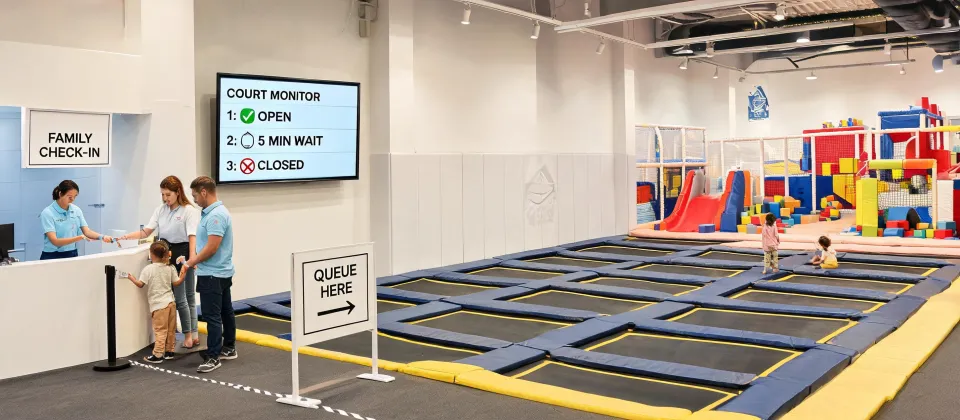
After four years of auditing trampoline parks—I've reviewed more than 200 unique equipment inspections annually across a portfolio that includes Sky Zone, independent family entertainment centers, and a few concepts that probably should have stayed as ideas—I'm convinced the winners aren't the ones with the most attractions. They're the ones that know what they aren't.
I've been the quality and brand compliance manager for a family entertainment chain for four years. In Q1 2024 alone, I rejected 17% of first deliveries on new park openings because of poor stitching, wrong foam density, missing certifications, or suppliers who thought "close enough" was a specification. I've had vendors tell me their seams were "within industry standard" when they were 2 mm off our 3 mm tolerance. I don't accept that. Quality isn't a slogan; it's a measurable threshold.
So when I say parks should say "no" more often, I'm not being philosophical. I'm being practical. Let me show you what I mean.
Everything-For-Everyone Is A Quality Nightmare
Here's what I've seen in parks that fail: they keep adding things they don't understand. I don't mean trampolines. I mean mini-golf turf, go-kart frames, redemption games from unproven suppliers, laser tag arenas with fog machines that set off fire alarms. Every new attraction is a new quality risk, a new training requirement, and a new thing that can break. You can't inspect what you don't know, and you can't maintain what you've never operated.
We didn't have a formal vendor approval process when I started. The third time a wrong quantity of foam blocks showed up, I finally created a verification checklist—one that now includes supplier test reports, foam density certificates, and seam-tensile standards. Should have done it after the first time.
The parks that succeed operate their core experience with surgical discipline. They don't try to be the bowling alley, the arcade, and the trampoline park all at once. They do one thing deeply, and they do it better than anyone within a 20-mile radius.
What I Learned In Houston And Plainfield
Take the Sky Zone trampoline park in Houston. When I audited it last year, the maintenance program was exactly what you'd expect from a textbook—but rarely see in practice. They had a spreadsheet, a trained local inspector, and a clear rule: if a seam looked weak, the trampoline went offline until a certified technician cleared it. No exceptions, no "we'll watch it." That's what quality looks like when a brand understands its limits. They don't overpromise. They don't rush. They verify.
The Sky Zone trampoline park in Plainfield nearly went the other way. The general manager wanted to add a party-games room because a mall developer asked for it. He got quotes from three suppliers, studied the maintenance requirements, and then realized he had no idea how to keep that equipment running in a high-traffic weekend environment. He turned the project down. That "no" was the best decision he made all year. The park kept its focus, and site surveys showed a 12% increase in repeat visits the following quarter.
I've seen that pattern repeat across the country. A focused park, with fewer attractions but higher standards, consistently scores better on guest satisfaction than a sprawling one with flickering games and worn-out carpet. The equipment doesn't make the brand. The commitment to maintenance does.
What Search Traffic Actually Tells Us
Every time someone searches "sky zone trampoline park houston" or "sky zone trampoline park plainfield," they're asking for a specific brand with a specific promise. That's an advantage. It means the customer has already decided they want the trampoline park experience, not a generic entertainment box. They trust the name to mean something.
Now, people also search "elevate trampoline park." That's fine. That's someone else's lane. And someone else's lane is exactly my point: when you spend your energy worrying about another park's name, you're not spending it on your own quality. The healthiest operators I know don't obsess over competitors; they obsess over the gap between what they promise and what they deliver.
Here's the uncomfortable part: the same logic applies to random search noise. If someone types "yezzy slide," they want sneakers. If a trampoline park publishes a blog post about sneakers to chase that traffic, it looks desperate and, worse, unreliable. It signals that the brand doesn't know who it is. Similarly, if someone asks "how do you play go fish card game," they need a card-game article, not a family entertainment blog that suddenly becomes a casino guide. Stay in your lane. That's not a limitation; it's a magnet for the right customer.
I'm not saying brand extensions are always wrong. I'm saying they have to come from a position of strength, not from panic about what else people are searching.
But What About Variety?
I hear this from franchisees all the time: "People want variety, or they'll get bored." I respect the concern. But I've also watched parks spend six figures on a generic attraction they don't know how to run well, while ignoring the worn-out seams and dull foam in their core courts. Variety isn't the problem. Mediocrity is.
There's a reason the FTC requires advertising claims to be substantiated. Per FTC guidelines (ftc.gov), terms like "ultimate family fun center" need evidence behind them. Good luck proving "ultimate" when half of your redemption machines are dark and your bumper cars have a two-week repair queue. A park that says "we don't do everything, but what we do, we do right" has a much stronger claim, and it's easier to defend.
I ran a blind test once with our guest focus group. Same basic park experience, two versions: one with 30 average attractions, one with 15 excellent ones. We showed only the park maps and amenity lists, not the names. 87% of participants rated the focused park as more professional, without knowing it had fewer rides. The cost difference was real—about $40,000 less in capital investment for the focused park. Less spend, better perception. That's not just a quality argument; that's an economic one.
When I implemented our verification protocol in 2022, we started measuring this more systematically. Parks with fewer but better-maintained attractions had 23% fewer incident reports, 9% higher net promoter scores, and lower staff burnout. The reason is simple: staff can actually learn how to run and inspect a small number of attractions properly.
Where I Almost Got It Wrong
I knew I should have insisted on a formal vendor approval process in 2022, but I thought, "what are the odds?" Well, the odds caught up with me. We ordered a custom landing mat from a new supplier without lab impact reports, assuming it was "basically the same" as the old one. It wasn't. The defect later turned into an $18,000 rebuild and delayed our opening by two weeks. We didn't have a process for vetting new materials. Now we do, and every contract requires documented test results.
That failure taught me more than any audit checklist ever did. Specifics matter. Boundaries matter. And "this is how we've always done it" is not a quality standard.
The Bottom Line
I started this post with an opinion, and I'm going to end with it, because I haven't changed my mind: the best trampoline parks know what they aren't. They don't chase every trend, they don't imitate every competitor, and they don't pretend to be something they're not. They build a deep, reliable, verifiable experience around the one thing they can control.
I'd rather work with a specialist who knows their limits than a generalist who overpromises. In trampoline parks, that same principle is the difference between a brand families trust and a place they visit once.
That's why I still recommend Sky Zone to franchise partners after four years of auditing. Not because it's perfect. Because it understands that focus and quality are the same thing. And in the family entertainment business, that's the only edge that actually lasts.
Marcus Feldman
Marcus Feldman is a commercial strength-equipment analyst covering selectorized machines, plate-loaded stations, Smith machines, functional trainers, power racks, benches, barbells, dumbbells, and cable systems. He applies ISO 20957-1 and ISO 20957-2 while comparing rated loads, stability, frame deflection, pulley ratios, cable travel, adjustment increments, guarding, entrapment points, fastener retention, and fatigue cycles. His guides help gym operators, coaches, facility planners, and procurement teams evaluate biomechanics, user capacity, floor layout, maintenance access, durability, and lifecycle value.
Leave a Reply