I Lost $400K Learning How Not to Build a Trampoline Park—What Sky Zone Got Right
-
The Space That Was Too Good to Be True
-
Mistake One: Designing on a Napkin
-
Mistake Two: The Pricing Spreadsheet That Lied to Me
-
Mistake Three: Three Systems, Zero Integration
-
The Foam Pit That Ended the Denial
-
A Franchise Rep Said Something I Didn't Expect
-
If You're About to Sign a Lease, Read This First
I spent most of 2018 convincing myself I could build a trampoline park from scratch—no franchise, no partner, no industry experience. I had retail experience, roughly $800K in savings and equity, and exactly zero knowledge of the family entertainment space. That combination is a recipe for losing money, and honestly, I lost plenty.
Search "sky-zone" on Google today and you'll see locations across the country. Back in 2018, I didn't understand why that consistency mattered. I thought I could build my own version for less and keep all the upside. Three years and $400K later, I know better.
Before I finally pulled the plug, I'd sunk around $400K into the project. Actually, it was closer to $380K—I'd have to check the old bank statements. The exact number isn't the point. The point is what the process taught me about layouts, pricing, technology, and why a proven system like the Sky Zone model beats reinventing the wheel. If you're a franchisee, a mall developer, or an investor looking at indoor entertainment, this one's for you.
The Space That Was Too Good to Be True
In June 2019, I signed a lease on a former big-box store: 36,000 square feet, below-market rent. The landlord was practically grateful to see me—the shopping center had been losing tenants for two years.
I stood in that empty building and saw unlimited potential. What I didn't see was the fire code requirements, the parking lot assessment, the HVAC retrofit, and the acoustic insulation (nobody warns you about how loud 200 jumping kids are). None of that made it onto my napkin budget.
I want to say my initial projection was $1.2M turnkey, but don't quote me on that—the real number kept inflating monthly. Equipment was the first rabbit hole. "Trampolines" sounds simple until you're researching ASTM safety standards, foam pit cube density specs, and the compliance paperwork your insurance broker demands before she'll even send you a quote.
Mistake One: Designing on a Napkin
My original layout was a big rectangle: trampolines on the left, dodgeball in the middle, foam pit on the right. It looked logical on a napkin. It was completely wrong, and I didn't realize it for months.
In August 2019, I spent weeks Googling "sky zone trampoline park rancho cucamonga photos" to study how a real location uses its space. Then I drove up there one afternoon and took photos like a tourist on a research mission.
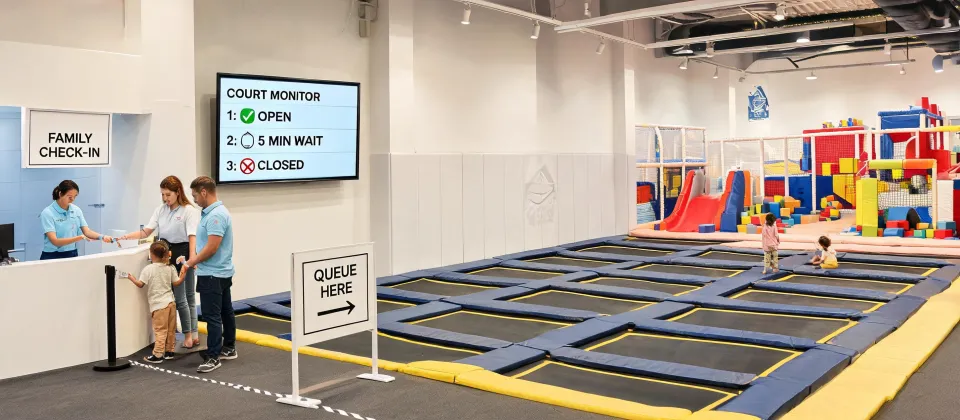
The sightlines hit me first. From the café, parents could see the entire main court and the party room entrance. From the front desk, staff could watch the arcade and the exit simultaneously. Attractions were zoned by noise and age: high-energy stuff together, toddler area tucked into its own corner with low-impact trampolines, party rooms grouped along one hallway so they didn't interfere with open jump.
Those photos became my unofficial blueprint. I must have looked at them a hundred times. My wife started calling it my trampoline park photo album—every spare moment, I was zooming in on netting heights, walkway widths, even where they put the hand sanitizer stations. Looking back, I was close to understanding something important: the real answer wasn't in the photos. The real answer was the system behind them. The people at Sky Zone had spent years measuring how kids moved, where lines formed, what made parents comfortable. They had real data guiding every decision. I had a napkin.
Mistake Two: The Pricing Spreadsheet That Lied to Me
By November 2019, I'd added a new problem to the stack: I had no idea how to price tickets. So I chose the "undercut everyone" strategy—20% below every competitor in the region. My logic: cheaper equals busier equals profitable. That's lemonade-stand logic, and it doesn't work in a capital-intensive business.
It didn't produce a meaningful bump in weekday attendance. It just made my margins so thin I started cutting hours to save labor. A death spiral, self-inflicted.
Meanwhile, I kept checking the sky zone trampoline park hampton tickets page. I remember sitting in my car in the Hampton parking lot, scrolling their ticket tiers on my phone, and feeling embarrassed for my own spreadsheet. They weren't just selling jump time—they were selling experiences. Toddler Time. All-You-Can-Jump passes. Birthday bundles with a dedicated host. Add-ons for laser tag and arcade credits. Every item had a name, a price, and a specific customer in mind.
Watching their pricing model was like watching someone play sevens who actually knew the rules: every card placed with intent, every move pushing toward a win. Meanwhile, I was still learning how to play sevens card game in the middle of a hand, losing points by the minute.
The deeper lesson wasn't about price points. It was about understanding who you're selling to. A parent planning a birthday party isn't comparing pennies between your park and the other park down the street. They're comparing a party they'll remember with a party they won't. Value perception beats discounts, every time.
Oh, and I committed a communication classic around the same time. I told my ticketing vendor to install the software "as soon as possible." They heard "whenever, the building isn't finished anyway." Result: I paid for a platform that sat silent for three months. Same words, completely different meaning. That one's on me.
Mistake Three: Three Systems, Zero Integration
Then came the technology nightmare. I bought a point-of-sale system from one vendor, waiver management from another, and a check-in validation tool from a third. Each worked beautifully in isolation. Together, they were chaos.
Getting them to talk to each other was exactly like my experience with the sony headphones connect app: everything looked compatible on paper, the app insisted it was connected, and then—nothing. The waiver station signed guests in but wouldn't update the POS customer records. The POS sold tickets, but the check-in tablet couldn't find the order. On a busy Saturday, roughly a third of entries didn't match bookings.
I spent entire evenings convinced I'd bought defective software. It wasn't a technology problem; it was a process problem. We had no integration workflow, no testing plan, no reconciliation routine. The third time the same failure hit us on a Saturday, I finally hired an IT contractor to map the entire flow and write a manual sync checklist. Should have done that after the first failure. (Franchise operators aren't perfect, but their corporate playbook at least tells them which systems work together before they buy.)
The Foam Pit That Ended the Denial
In October 2020, the foam pit cubes arrived damp. Forty-seven bags of high-density foam, all of them retaining moisture from warehouse storage. The install failed inspection. $18,000 in foam, $9,000 in shipping and re-handling, three weeks of construction delay.
My insurance broker had warned me about humidity in that region. She literally said, "get a moisture meter." I didn't. Twenty-seven thousand dollars later, I own three moisture meters and a deeply personal relationship with the concept of dew point. Some lessons are just expensive.
Standing over those swollen foam bags, I finally admitted what I'd been avoiding for a year: I was in over my head. So I did what I should have done in 2019—I called someone who had built trampoline parks for a living.
A Franchise Rep Said Something I Didn't Expect
The Sky Zone franchise development team agreed to meet me. I walked in braced for a high-pressure sales pitch. Instead, fifteen minutes in, the rep said something that cut right through me:
"Honestly, a franchise might not be the right fit for what you're dealing with right now."
That sentence completely changed the energy of the room. Then he walked me through their model: what Sky Zone does well (site selection, standardized attractions, operations playbooks, training), and what franchisees own themselves (local marketing, community relationships, grassroots growth). He walked me through the FDD—the franchise disclosure document that FTC regulations require, and you can verify that on ftc.gov. "Everything you need to know is in here," he said. "The good and the ugly."
That conversation rewired my definition of a good partner. A partner who says "we're great at this and not great at that" is a partner you can trust with the work you can't do yourself. A vendor who says "we do everything" is usually telling you they're excellent at nothing. I'd rather work with a specialist who knows their limits than a generalist who overpromises. That principle now applies to every business decision I make—franchise partners, suppliers, you name it.
If You're About to Sign a Lease, Read This First
If you've ever had a project balloon into a money pit, you know the sinking feeling. I still kick myself for not talking to an experienced operator before I signed that lease. One conversation could have saved me most of the $400K.
Here's the checklist I share with anyone in my network who asks about opening an indoor entertainment venue:
- Talk to an experienced operator before signing anything. Ask them what they'd never do again—then write it down.
- Budget for engineering, compliance, and insurance in the first pass. Not the fourth.
- Visit at least three successful locations in person. Photograph sightlines and circulation, not just the fun stuff.
- Study pricing like a business owner, not a customer. Deconstruct their tiers and bundles.
- Test every system integration before opening weekend. Waiver → point-of-sale → check-in. If it breaks, fix it before real customers arrive.
- Ask every potential partner: "What are you not good at?" If the answer is "nothing," walk away.
- Check the regulations before you do anything clever. We nearly got a $5,000 federal fine for putting flyers in residential mailboxes. Under 18 U.S. Code § 1708, only USPS-authorized mail belongs in a residential mailbox. Our marketing team didn't know that. Now I do.
And the best part of finally having this checklist? I sleep again. There's a real satisfaction in understanding how a well-run operation works. I sat in a Sky Zone café a few months ago—not researching this time, just watching—and I saw it clicking: the line moving, the waiver kiosks feeding the POS, the party host hitting every checkpoint. It looked like watching someone play spit card game at top speed: relaxed hands, fast reactions, zero panic. It looks like luck if you don't know the rules. But it's not luck. It's a system, and the system respects its own limits.
I'm not here to say every independent operator is doomed. I know a handful running excellent parks without a franchise. But if you're coming into this industry from the outside—like I was—don't let the learning curve eat your savings. Find people who'll tell you what they can't do before you hand over what you've got. Take it from someone who paid $400K for that lesson: ask for help early, trust honest specialists, and don't try to be the smartest person in the room when you're clearly the least experienced one.
Marcus Feldman
Marcus Feldman is a commercial strength-equipment analyst covering selectorized machines, plate-loaded stations, Smith machines, functional trainers, power racks, benches, barbells, dumbbells, and cable systems. He applies ISO 20957-1 and ISO 20957-2 while comparing rated loads, stability, frame deflection, pulley ratios, cable travel, adjustment increments, guarding, entrapment points, fastener retention, and fatigue cycles. His guides help gym operators, coaches, facility planners, and procurement teams evaluate biomechanics, user capacity, floor layout, maintenance access, durability, and lifecycle value.
Leave a Reply