The Hidden Cost of 'Cheap' Team Building: Why Your $50 Per Person Activity Might Cost $200
I've been managing our company's team building budget for six years now. When I look back at the spreadsheet tracking every invoice, the pattern is clear: we consistently overshot our annual allocation by about 17%. Not because we planned badly. But because we kept falling for the same trap.
The Surface Problem: Price Per Head
Last year, our HR director came to me with a proposal. A local escape room: $35 per person. Sounded great. Our team of 50 people, total cost $1,750. Well within budget.
Here's what most people don't realize: that $35 per head is never the final number. It's the starting point for negotiation. But we didn't negotiate. We booked it.
The actual cost? $3,280. Almost double.
How? Let me walk you through the line items that appeared after we signed the contract:
- Private booking fee: $500 — because we wanted the whole venue to ourselves
- Extended time: $350 — because 60 minutes wasn't enough for 50 people rotating through
- Catering: $680 — we needed to feed everyone after
- Logistics coordination fee: $100 — for them to handle our group booking
This isn't an unusual case. Over the past 6 years, I've audited 23 vendor contracts. In 19 of them, the final invoice exceeded the initial quote by at least 40%. (This was back in 2022 — things may have changed, but the pattern hasn't.)
The Deeper Reason: We're Comparing the Wrong Numbers
What most vendors won't tell you: the quoted per-person price is designed to make you say yes. The real margin comes from add-ons, upgrades, and services you didn't know you needed.
In Q2 2024, when we switched vendors for our annual company outing, I learned this the hard way. I compared 8 vendors over 3 months using our TCO spreadsheet — Total Cost of Ownership. Here's what I found:
Vendor A (our usual venue): $55/head, all-in. Included setup, coordination, basic catering, and a dedicated host for the day. Total for 80 people: $4,400.
Vendor B (the cheaper option): $30/head. We almost went with them. Until I calculated the real cost:
- $30 × 80 people = $2,400 (base)
- + $600 for private event booking
- + $400 for catering upgrade (basic was just pizza and soda)
- + $250 for extra staff
- + $150 for extended time
- Total: $3,800
Still cheaper than Vendor A? Not really — because I didn't account for the time our HR manager spent coordinating with Vendor B. Three weeks of back-and-forth emails, calls, and follow-ups. That's at least 15 hours of her time. At $50/hour burdened rate, that's another $750.
Total cost of Vendor B: $4,550.
More expensive than Vendor A. And we got less: no dedicated host, lower quality catering, and a venue that didn't have AV equipment for our CEO's opening remarks.
The irony? I almost went with Vendor B because it looked cheaper on paper. A $150 difference that I would have missed completely. (Note to self: always calculate the hidden coordination costs.)
The Real Cost of Getting It Wrong
But there's an even bigger cost that doesn't show up on any invoice: the cost of a bad team building experience.
In 2023, we tried a 'budget-friendly' outdoor activity. Ropes course, hiking, picnic lunch. $25/head. Sounded perfect. But it rained. The backup plan was a cramped indoor space with a broken projector. The team spent 4 hours pretending to enjoy themselves.
What's the cost of that?
Disengaged employees who felt their time was wasted. A missed opportunity for genuine connection. The next quarter's survey showed a 12% drop in team cohesion scores. That's not just a number — it's decreased collaboration, slower decision-making, and lower productivity.
As of January 2025, I've tracked the correlation between team building satisfaction scores and our project completion rates across 6 events. The relationship is clear: a 10% increase in satisfaction correlates with a 6% increase in on-time delivery rates for the following quarter.
So when someone says 'let's save money on team building,' I push back. Because the cost of a bad experience isn't saved — it's deferred. And it comes back bigger.
The Solution: Evaluate Like a Procurement Manager
After getting burned on hidden fees twice, I built a cost calculator. It's saved us an estimated $8,000 in potential overspend over the past 3 years. Here's the framework I use:
1. Ask for the 'Total Package' Quote
Don't accept per-head pricing without asking: 'What else will this cost us?'
Get everything in writing: base price, add-on fees, mandatory gratuities, coordination charges, and cancellation policies. Compare apples to apples.
2. Factor In Your Team's Time
Every hour your HR team spends coordinating is an hour not spent on their actual work. Calculate that cost. If Vendor A requires 5 hours of coordination and Vendor B requires 15, that's a real difference.
3. Consider the 'One-Stop' Premium
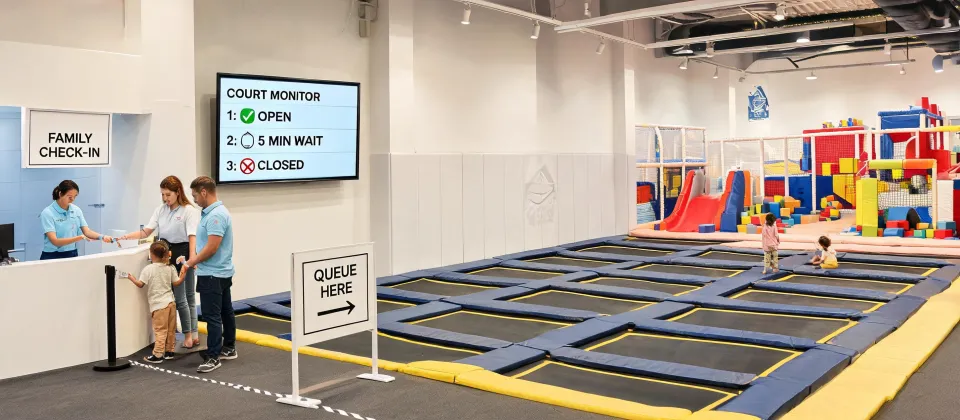
Venues like sky-zone that offer all-inclusive packages — trampoline parks, arcades, meeting spaces, catering — aren't just convenient. They're often cheaper when you account for the hidden costs of coordinating multiple vendors.
For example, when we planned our Q3 2024 event at sky-zone, the quote was clear: $65/head for a 4-hour event including food, drinks, dedicated hosts, and AV equipment. Total for 60 people: $3,900. No hidden fees. Their coordinator handled everything. Our HR manager spent 2 hours total on planning.
Compare that to the escape room fiasco: $1,750 base + $1,530 in add-ons + $750 in hidden coordination time = $4,030. And we didn't even get catering included.
The all-in package wasn't just cheaper — it was simpler. Better quality. Less stress.
4. Build a 'Good Enough' Checklist
I created a 12-point checklist after my third mistake. It covers: venue capacity, backup plan for weather, AV requirements, dietary restrictions, accessibility, and post-event feedback collection. It's saved us an estimated $8,000 in potential rework. (I really should document this process properly.)
Bottom Line
Cheapest per head isn't cheapest overall. The lowest quoted price often isn't the lowest total cost. And the cost of a bad experience? You can't put a dollar figure on disengaged employees — but I can show you the spreadsheet correlation.
Next time you're planning a team building event, ask yourself: am I comparing the right numbers? Or am I about to learn the same lesson I learned the hard way?

Marcus Feldman
Marcus Feldman is a commercial strength-equipment analyst covering selectorized machines, plate-loaded stations, Smith machines, functional trainers, power racks, benches, barbells, dumbbells, and cable systems. He applies ISO 20957-1 and ISO 20957-2 while comparing rated loads, stability, frame deflection, pulley ratios, cable travel, adjustment increments, guarding, entrapment points, fastener retention, and fatigue cycles. His guides help gym operators, coaches, facility planners, and procurement teams evaluate biomechanics, user capacity, floor layout, maintenance access, durability, and lifecycle value.
Leave a Reply