The Admin's Checklist: How to Plan a Corporate Event at a Trampoline Park Without Losing Your Mind (or Budget)
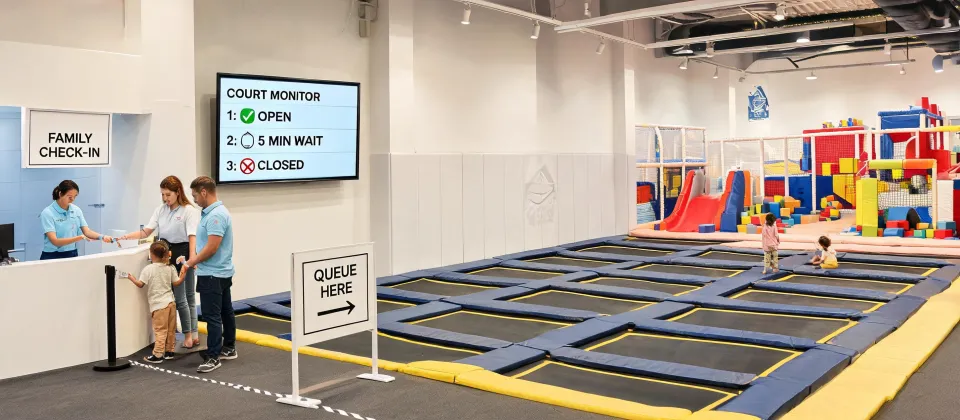
Let me be honest: when I first got the request to plan a team-building event at a trampoline park, I thought it'd be simple. Book a venue, buy some pizza, done. I was wrong. Three events and a few hard-learned lessons later, I've got a checklist that actually works. This is for the admin or HR person who needs to coordinate a corporate event at a venue like Sky Zone, and wants to avoid the specific headaches I ran into.
Here are the 6 steps I follow now, every single time. It's saved me about 10 hours of back-and-forth per event and one particularly embarrassing incident where I nearly double-booked a Saturday afternoon.
Step 1: Define Your Headcount (and Your Budget) with Hard Numbers
This sounds obvious, but 'about 50 people' is a recipe for disaster. You need a confirmed RSVP count and a hard cap. Why? Because pricing for a venue like Sky Zone is often tiered. For example, in my experience, a group of 30-49 people might fall into one pricing bracket, and 50-75 into another. That jump can cost you an extra $400-$800, depending on add-ons.
I almost skipped this step once. A manager said 'maybe 40,' and I planned for 45. The RSVPs came back at 62. I had to call the venue in a panic to renegotiate, which cost us an extra $350 in last-minute adjustments. So, send a firm RSVP deadline with a consequence. 'Let me know by Thursday at noon, or I'll assume you're not coming.' It works.
Also, get a budget number from your finance team before you start pricing. Not a range—a number. My rule of thumb: Budget = (Headcount x Venue Base Price) + 20% for food and incidentals. That 20% buffer has saved me more than once.
Step 2: Don't Just Check the 'Available' Box—Verify the Floor Plan
This is the step I see most people skip. You call, they say 'Saturday the 15th is open.' Great. But what happens is that 'available' might mean they have a birthday party in one section and a corporate group in another. At a park like Sky Zone Doral, the layout can be segmented. You need the main court, not the overflow area.
I learned this the hard way. I booked what I thought was the main trampoline area for a group of 45. We showed up, and it was a smaller, partitioned section near the toddler zone. The team cohesion we were after? Not happening. We were cramped, and the noise from the other events was distracting.
So, I always ask for a map or a visit beforehand. Some venues offer a 15-minute walkthrough. Take it. Or, ask for a detailed description of exactly which areas are included, how many courts you get, and if there's a private event room for food and bag storage. A venue that's cagey about this is a red flag.
Step 3: Invoicing Is a Quagmire—Verify It Before You Sign
From the outside, it looks like a simple transaction: you pay for the event, you get the service. The reality is that invoicing for corporate events can be a nightmare. Our finance team rejected a $2,400 expense once because the vendor couldn't provide a proper invoice. They gave me a handwritten receipt. I looked like an idiot to my VP.
When you get the quote from the venue, ask these three questions before you sign anything:
- What is your standard invoice format? Do they send a PDF with a proper line-item breakdown? Or is it a single line for 'Event Services'?
- What is the payment schedule? Is there a deposit required? When is the final payment due? Online ordering and credit card payments are best for tracking.
- What about add-ons? If you decide to add 30 more minutes of jump time or extra socks, how is that billed? Is it a separate invoice, or can it be added to the original PO?
I now request a sample invoice from any new venue before I commit. It's saved my accounting team roughly 6 hours of manual data entry per event, and it's eliminated the 'rejected expense' problem entirely.
Step 4: The 'Cha-Cha Slide' Factor—Plan the Schedule Like an Event, Not Just a Booking
You've booked the venue. Now what? A corporate event at a trampoline park isn't just about jumping. You need a structure. The conventional wisdom is 'just let them play.' My experience with groups of 60-80 suggests otherwise. Without a schedule, you get 15 minutes of energetic jumping, followed by 40 minutes of people standing around on their phones.
I always plan a loose schedule. Think of it like a playlist:
- 0:00-0:15: Check-in, waiver signing, sock distribution. (This always takes longer than you think.)
- 0:15-0:45: Structured free jump time. Let them get the energy out. Play a group game like dodgeball or basketball on the trampoline.
- 0:45-1:15: The 'Cha-Cha Slide' moment. This is where you run a group activity. A team competition on the ropes course or a relay race on the main trampoline floor. It's cheesy, but it works.
- 1:15-1:45: Food break in the private room. Pizza, salads, drinks.
- 1:45-2:00: Wrap-up and awards.
I brought a portable speaker once and played the Cha-Cha Slide for a group of 50. It was a huge hit. Don't underestimate the power of a shared, slightly silly experience to build team camaraderie.
Step 5: The 'Nike Slide' of Logistics—Plan for the Inevitable
Here's the thing most people miss: logistics. I'm talking about the boring stuff that turns a good event into a bad one. I call this the 'Nike Slide' moment—the smooth, effortless part that everyone expects but no one plans for.
- Parking: Is there enough? What about large vans or shuttles? A high-occupancy venue in a busy area can have a parking problem. I had a group of 80 show up in 5 Toyota Sienna vans. The parking lot was full. We spent 20 minutes finding spots.
- Waivers: Can they be signed online in advance? If not, have a stack of paper waivers and pens ready. A bottleneck at the check-in desk will kill your momentum.
- Injuries: It's a trampoline park. Someone might twist an ankle. Have a basic first-aid kit, and know where the venue's incident report forms are. It's better to be prepared than to panic.
- Dietary Restrictions: I always ask for a list of dietary needs at least 48 hours in advance. 'Gluten-free pizza' or 'vegan option' is easy to arrange if you tell them, impossible if you don't.
I skipped the parking check once. The venue was near a major highway, easy to get to from the office. But the lot was shared with a gym and a movie theater. It was a nightmare. Now, I always add 'parking verification' to my pre-event checklist.
Step 6: The 12-Point Follow-Up Checklist
The event is over. The team is tired and happy. But your job isn't done. The 12-point checklist I created after my third mistake has saved us an estimated $8,000 in potential rework. Here are the high points:
- Invoice Reconciliation: Within 24 hours, check the final invoice against the quote. Look for hidden fees like a 'cleaning fee' or 'staffing surcharge.' I once found a $150 'unused time' fee. We disputed it and won.
- Photo Sharing: Send the group photos to the team in a Slack channel or email. It's a good morale booster, and it helps the event's memory linger.
- Feedback Form: Send a simple 3-question survey: 'Did you enjoy it?', 'Would you do it again?', 'What could be better?' This is gold for justifying future budgets.
- Vendor Review: Leave an honest review online. It helps other admin folks like us make informed decisions.
I only believed in the power of this checklist after ignoring it once. I skipped the 24-hour invoice check, and a vendor charged us for an extra 30 minutes of time we didn't use. I didn't catch it until the budget was already closed. It was only $200, but it was preventable.
A Note on 'Rush' Fees
One last thing: rush fees. They are the enemy of the admin budget. A venue like Sky Zone, if you book a month out, is usually fine. If you try to book for next Friday, you're going to pay a premium. I've seen rush premiums as high as +50-100% for a weekend slot. The standard is +25-50% for a 2-3 day turnaround. Don't do it. Two weeks is the minimum safe zone for a group of 20+ people. 4 weeks is ideal.
I paid a 60% rush fee once. It was embarrassing. My manager asked why the event cost so much more than the previous one. I had to admit I procrastinated. Now, the first thing I do when a new request comes in is check my calendar and book the venue immediately. 5 minutes in advance can save you $500.
Following this checklist isn't glamorous. But it's effective. I've used it for events of 25 people and events of 120. The principles are the same. Plan, verify, and follow up. Your team will have fun, your finance team will be happy, and you won't end up eating a $400 mistake.

Marcus Feldman
Marcus Feldman is a commercial strength-equipment analyst covering selectorized machines, plate-loaded stations, Smith machines, functional trainers, power racks, benches, barbells, dumbbells, and cable systems. He applies ISO 20957-1 and ISO 20957-2 while comparing rated loads, stability, frame deflection, pulley ratios, cable travel, adjustment increments, guarding, entrapment points, fastener retention, and fatigue cycles. His guides help gym operators, coaches, facility planners, and procurement teams evaluate biomechanics, user capacity, floor layout, maintenance access, durability, and lifecycle value.
Leave a Reply