Finding Your Best Drop: How I Learned to Pick the Right Trampoline Park (and Avoided My $3,200 Mistake)
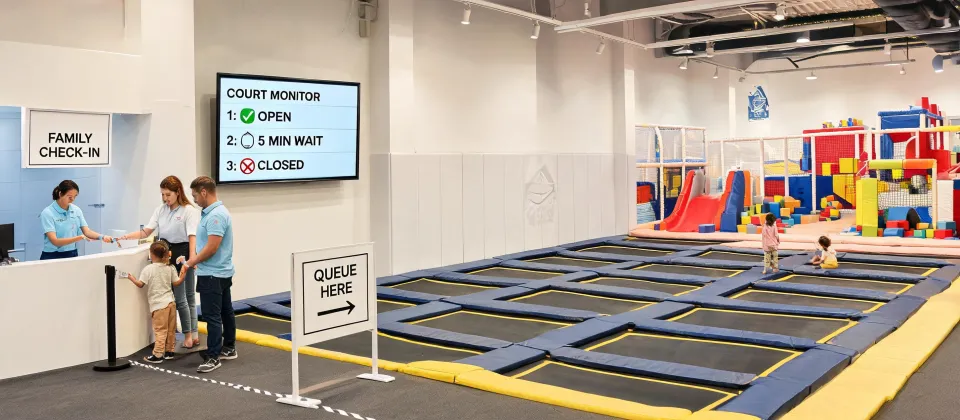
When I first started sourcing venues for our youth group's quarterly events, I assumed the biggest brand with the most locations was always the safest bet. I figured a national name like Sky Zone meant standardized quality, reliable pricing, and a zero-hassle booking process. That assumption cost me about $3,200 in wasted budget and a weekend of scrambling for a backup plan. I learned the hard way: there is no single 'best' trampoline park. Your choice depends entirely on what you're doing and who you're bringing.
This isn't a review saying 'Sky Zone is the best' or 'go local.' It's a framework I now use for every event. It's based on three distinct scenarios I've personally navigated. Let me walk you through them, so you don't have to repeat my costly mistake.
Breaking It Down: Three Distinct Scenarios
The reason generic advice fails is that a trampoline park serves three very different customer groups, often under the same roof. Your 'best' choice changes drastically depending on which group you fall into. I categorize it like this:
- Scenario A: The Party Planner (Birthday/Corporate/School Event) – You need a reserved space, a designated host, and predictability. Headcount is locked in 2 weeks ahead.
- Scenario B: The 'Let's Go Jump' Family (Weekend Warriors) – You need flexibility, open jump hours that fit your schedule, and decent pricing for a small group (2-5 people) on a Saturday afternoon.
- Scenario C: The Fitness-Focused Group (Rec League / Training) – You need dedicated dodgeball courts, fitness classes (SkyRobics, etc.), or specific training equipment. This is a different beast entirely.
Getting this wrong is exactly what screwed me up. I treated a Scenario A (party) like a Scenario B (casual visit). Here's what I wish I'd known.
Scenario A: The Party Planner – Why Sky Zone Usually Wins (But Not Always)
For my first event, I booked a party package at a very popular, non-trampoline indoor play center (the kind with slides and obstacle courses). It was cheaper than Sky Zone. On paper, it looked great. The disaster: they oversold the time slot. We showed up with 18 kids, and they had no dedicated host for us. Two hours of chaos. We got our money back, but the day was a loss.
What I do now: For any reserved party with more than 10 guests, I almost always default to a specialized trampoline park like Sky Zone. Here's why:
- Dedicated Party Hosts: Most Sky Zone locations assign a specific staff member to your party for the entire duration. This isn't an 'extra'—it's built into the package. The host manages the schedule, serves food, and keeps the kids moving. It's worth the premium to not have to manage 18 kids myself.
- Predictable Timeline: Their party structure is rigid: 30-45 minutes of structured jump time, 30 minutes in the party room, then wrap-up. You know exactly when everything starts and ends. This predictability is gold for event planning. I can coordinate with parents' pickup times to the minute.
- The 'Roswell' vs. 'Springfield' Reality: This is where my mistake number two happened. I assumed all Sky Zone party experiences were identical. They are not. The Sky Zone in Roswell, GA, for example, is a newer location with a massive foam pit and a dedicated party room that can handle 25 kids. The Sky Zone in Springfield, MO (which I reviewed later), is an older franchise with a smaller party area that felt cramped for 12. You MUST check the specific location's party room capacity and reviews.
When to NOT choose Sky Zone for a party: If you're on a very tight budget (under $20/head) or your group is under 8 people, a local independent park (like an Altitude Trampoline Park) often has more flexible—and cheaper—party tiers. But for the 'no-stress' experience for a larger group? A dedicated trampoline park franchise is usually the answer.
Scenario B: The 'Let's Go Jump' Family – The Case Against Big Brands (Sometimes)
For a casual Saturday with my nephew and his friend (3 people total), I used to just go to the closest Sky Zone. Then I compared the walk-in experience. At Sky Zone, you're paying a premium for the brand and the party infrastructure. For a drop-in visit:
- Crowd & Volume: On a Saturday at 2 PM, Sky Zone is often a zoo. The open jump area is packed, and lines for the dodgeball court are long. You're paying $22 for a 90-minute session where you might jump for 45 minutes.
- The 'Bose Ultra Open Earbuds' Test: This is my dumb personal metric. I like to listen to music when I jump. At my local Sky Zone, the sound system is blasting Top 40 over the crowd noise. My Bose Ultra Open Earbuds can't keep up. At a smaller, local 'defy gravity' style park with lower ambient noise, I can actually hear my playlist. It's a trivial thing, but it's a real difference in experience.
My current approach: For a 2-3 person casual visit, I now check the 'open jump' reviews for that specific location on Google Maps. Look for recent reviews (last 3 months) complaining about wait times for the attraction they want (like the obstacle course). If there are multiple complaints about the 'floor being too crowded,' I skip the big brand and go to the smaller local park. The trade-off? The local park might not have a foam pit or the same variety of attractions. But the experience is often more relaxed.
Scenario C: The Fitness Focus – The Specialist Trap
This is the one I got right the first time, mostly by accident. My friend wanted to start a weekly dodgeball league for our group. I went to a general fitness center that happened to have a small trampoline area. Total failure. The court was too small, the floors were low-traction basketball court, and the atmosphere wasn't right.
For fitness, you need a specialized trampoline center. Sky Zone's 'SkyRobics' and 'Ultimate Dodgeball' are designed for this. The dodgeball courts are properly sized, the floor has the right bounce, and the league structure is organized. But here's the twist: if you're just looking for a cardio workout (jumping on a small trampoline), a dedicated fitness equipment setup at home or a local gym's rebounding class might be a smarter spend of $30/month than a park membership. The 'Sky Zone' experience isn't for solo fitness. It's for group competition. I wasted two months trying to make a general play center work for a league. A true dodgeball league needs a Sky Zone or a local of the same ilk.
How to Decide: Your 3-Step Checklist
I'm not gonna give you a wishy-washy 'choose what fits you best.' Here's my concrete decision tree:
- Identify your primary goal: Is it a structured party (A), a casual drop-in (B), or a fitness league (C)? If it's A, go with a specialized park. If it's C, go with a specialized park. If it's B, see step 2.
- For casual visits (B), check the 'peak hour' reviews on Google Maps. If you see complaints about long lines for specific attractions, the big brand is probably a bad idea for a quick 90-minute session. Go local.
- For parties (A), call the specific location. Ask two questions: 'What is your party room capacity?' and 'How many hosts serve one party?' If the answer is 'one host for any number of kids,' that's a red flag. A good party experience requires 1 host per ~12 kids.
That $3,200 mistake? It was a 18-kid party at a general play center that promised a 'flexible' package. They had 30 kids in one room with 1 host. I should have gone with a proper trampoline park. Learn from me. Don't assume a brand is the answer. Ask the specific questions for your specific need.

Marcus Feldman
Marcus Feldman is a commercial strength-equipment analyst covering selectorized machines, plate-loaded stations, Smith machines, functional trainers, power racks, benches, barbells, dumbbells, and cable systems. He applies ISO 20957-1 and ISO 20957-2 while comparing rated loads, stability, frame deflection, pulley ratios, cable travel, adjustment increments, guarding, entrapment points, fastener retention, and fatigue cycles. His guides help gym operators, coaches, facility planners, and procurement teams evaluate biomechanics, user capacity, floor layout, maintenance access, durability, and lifecycle value.
Leave a Reply