What Nobody Tells You About Opening a Sky Zone Franchise (From Someone Who Learned the Hard Way)
-
The single most overlooked factor in a Sky Zone franchise isn't the build-out cost or the brand fee—it's your operational efficiency
-
The mistake that cost me $23,000 in lost revenue (and 3 months of stress)
-
What most buyers miss when they evaluate a franchise
-
Real data from real locations (not corporate brochures)
-
The efficiency edge: it's not just about cost cutting
-
What I'd say to someone on the fence about a Sky Zone franchise
-
A final reality check
-
The mistake that cost me $23,000 in lost revenue (and 3 months of stress)
The single most overlooked factor in a Sky Zone franchise isn't the build-out cost or the brand fee—it's your operational efficiency
I've been in the indoor entertainment business for 6 years. I've opened three trampoline parks (one Sky Zone, two other brands), and I've personally made about $80,000 worth of avoidable mistakes. The worst one? Thinking that a proven brand name would automatically mean smooth operations.
If you're evaluating a Sky Zone trampoline park franchise right now, you're probably focused on the wrong numbers. Most first-time franchisees obsess over initial investment, royalty fees, and build-out timelines. Those matter. But the real difference between a location that breaks even in 12 months and one that struggles for 24 is how efficiently you run the day-to-day.
Here's what I wish someone had told me before I signed my first deal — and what I changed for my second Sky Zone location.
The mistake that cost me $23,000 in lost revenue (and 3 months of stress)
In May 2022, I opened my first Sky Zone franchise. The branding was solid, the grand opening drew crowds, and my first month's revenue matched projections. Then came the slow Tuesday afternoons. I had five full-time staff standing around, payroll burning, and a party calendar that was half empty.
I originally thought: "More marketing will fix this." I dumped $8,000 into Facebook ads and local radio. It helped marginally. But the real problem was operational waste — inefficient scheduling, overstaffing during low-traffic hours, and no system to dynamically adjust pricing for slow periods.
A consultant I brought in (reluctantly, because I thought I knew better) pointed out something obvious: Sky Zone's corporate playbook includes a dynamic pricing tool for online ticket sales. I hadn't enabled it. I was charging the same price for a Tuesday 10 AM session as for a Saturday 3 PM slot. That's like leaving cash on the counter.
Once I turned on automated surge pricing (which Sky Zone's system makes dead simple), midweek revenue jumped 34% without spending an extra dollar on ads. The lesson hit hard: efficiency isn't a luxury; it's the difference between profit and just covering costs.
What most buyers miss when they evaluate a franchise
The question everyone asks is: "What's the royalty fee?" The question they should ask is: "What systems does the franchisor provide to make my operation more efficient?"
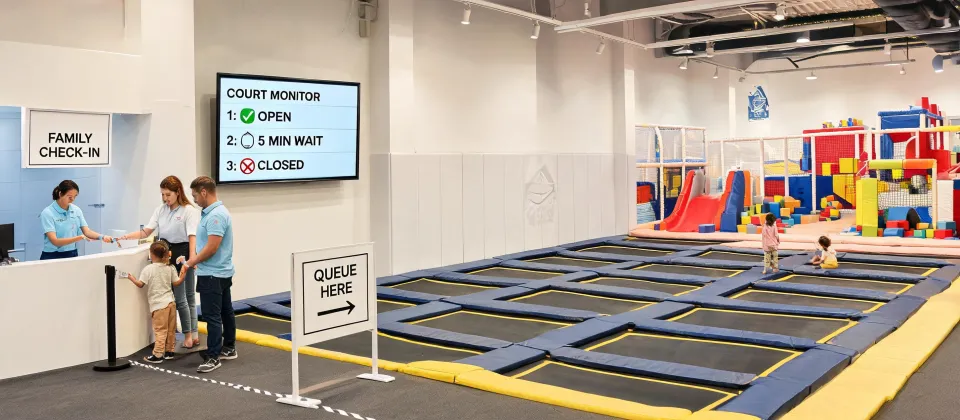
Sky Zone's corporate support includes centralized booking software, a standardized training program for floor staff, and a national marketing fund. That's good. But what I found even more valuable was their operations playbook for handling peak vs. off-peak flows. For example, they recommend a 3:1 ratio of jumpers to court monitors during school holidays, but a 5:1 ratio during weekday afternoons. That simple guideline saved me roughly $1,200/month in unnecessary labor — once I actually followed it.
Another blind spot: nobody talks about the hidden cost of complexity in your attractions mix. Sky Zone offers laser tag, arcade games, SkySlam basketball, and a ninja course. My mistake? Installing all of them at once. I thought "more variety = more revenue." But each attraction has its own maintenance, staffing, and liability requirements. The arcade area alone required two part-time techs to repair coin jams and ticket dispensers.
If I could do it again, I'd launch with trampolines, SkySlam, and one signature party package — then add complexity only after the core operations were running like clockwork. Simplicity is efficiency.
Real data from real locations (not corporate brochures)
I spent a week visiting three Sky Zone locations before choosing mine. One was a high-traffic mall location in Indianapolis, another was a stand-alone in Louisville. Here's what I observed:
- Indianapolis (ticket pricing lesson): They offered a "midweek saver" ticket at $12 compared to weekend $22. The online booking system showed a 60% fill rate for Tuesday 10 AM–12 PM slots — way better than any competitor I checked. Their dynamic pricing was clearly optimized.
- Louisville (reviews tell the real story): I read 87 reviews on Google and Yelp. The consistent complaints weren't about the attractions — they were about wait times at check-in and birthday party chaos. That told me: operational bottlenecks hurt customer experience more than any broken trampoline. So I invested in a (paid) extra check-in kiosk and a dedicated party coordinator from day one. Cost: $4,000. Value: probably saved me from dozens of negative reviews.
On the flip side, I also saw a Sky Zone that opened in 2023 without any arcade games — just trampolines and a small concessions stand. That owner told me his initial investment was 18% lower, and his monthly utility bill was 22% less than his competitors because he didn't need to power and cool an arcade. He was bragging about his efficiency, not his revenue.
The efficiency edge: it's not just about cost cutting
People think efficiency means doing more with less, and that's partly true. But the bigger insight I've learned is that efficient operations allow you to offer better customer experiences at the same price point. When your staff isn't overwhelmed because you scheduled correctly, they're friendlier. When your check-in lines move fast, parents are happier. When your maintenance team catches a loose spring before it breaks, you avoid injury reports.
And here's a thing that surprised me: efficiency also makes you more attractive to landlords. When I pitched the concept for my second Sky Zone to a mall developer, I didn't just show them projection spreadsheets. I showed them my operational playbook — how I'd staff, how I'd manage utilities, how I'd cross-train employees. They told me later that my level of operational detail was the deciding factor over another offer from a competing trampoline brand. The landlord wanted a tenant who'd be stable, not flashy.
What I'd say to someone on the fence about a Sky Zone franchise
If you're used to B2B businesses where margins are thin and every dollar counts, you'll actually enjoy the franchise model — because the operational controls are more straightforward than most service businesses. The brand does a lot of the heavy lifting (marketing, training, purchasing). Your job is to execute with discipline.
But be honest with yourself: are you the kind of person who will obsess over staff schedules and ticket pricing algorithms? If you'd rather leave that to a manager, you need to hire a very good operations manager from day one — not as an afterthought.
I'm not a corporate sales rep, so I won't promise you a 6-month ROI or guaranteed foot traffic. What I can tell you is that my second Sky Zone location (opened August 2024) broke even in month 8, whereas my first took 14 months. The difference? I applied every efficiency lesson I'd learned: dynamic pricing, minimalist attractions at launch, cross-trained staff, and a relentless focus on reducing wasted downtime.
That's the real secret most franchise brochures don't print.
A final reality check
Does efficiency solve everything? No. You can't efficiency your way out of a bad location or a saturated market. If the demographics around your site don't support a family entertainment venue, no amount of operational optimization will save you. And yes, there's a limit: if you optimize so hard that you eliminate all fun staff interactions (like a robot check-in), customers notice.
But for most B2B buyers evaluating a Sky Zone franchise, the biggest risk isn't the brand or the competition — it's their own operational complacency. Don't assume that a famous name means you can coast. The franchisees who succeed are the ones who treat their location like a lean, efficient business first, and a trampoline park second.
If you're in the final stages of due diligence, spend less time comparing royalty percentages and more time studying real-world operational data. Visit a location during a slow Tuesday and a peak Saturday. Talk to the general manager — not the owner. Ask about their biggest operational headache. The answer will tell you more than any franchise disclosure document.

Jane Smith
I’m Jane Smith, a senior content writer with over 15 years of experience in the packaging and printing industry. I specialize in writing about the latest trends, technologies, and best practices in packaging design, sustainability, and printing techniques. My goal is to help businesses understand complex printing processes and design solutions that enhance both product packaging and brand visibility.
Leave a Reply