The Franchisee's Quality Checklist: How to Audit a Sky Zone Trampoline Park Before You Invest
-
Who This Checklist Is For
-
Step 1: Verify Brand Consistency at the Parking Lot
-
Step 2: Audit the Jump Court Safety Checklist
-
Step 3: Talk to the General Manager About Training
-
Step 4: Check the Arcade and Party Room Quality
-
Step 5: Review the Local Marketing and Competitive Landscape
-
Bonus: Why Small Investors Shouldn't Be Scared Off
-
Common Mistakes to Avoid
Who This Checklist Is For
If you're looking at opening a Sky Zone trampoline park—whether as a franchisee, mall developer, or venue investor—you need more than a glossy brochure. You need to verify that the brand delivers on its promises at the park level. This checklist is built for people who've done their initial research and are ready to kick the tires. I'll walk you through 5 practical steps to assess a Sky Zone location before you sign anything.
Full disclosure: I'm a quality compliance manager for a family entertainment brand. I review roughly 200+ franchise deliverables a year—from safety protocols to guest experience audits. I've rejected about 15% of first-round submissions in 2024 because they missed spec. So I'm not easily impressed. That's the lens I'm bringing here.
Step 1: Verify Brand Consistency at the Parking Lot
Start before you walk in. Check the exterior signage, cleanliness, and how the building presents itself. Sky Zone has specific brand guidelines for storefronts. Grab your phone and take a photo. Compare it to the official Sky Zone store design template (they provide it in franchise onboarding).
What to look for:
- Color matching—Sky Zone's signature green and orange should be consistent with Pantone specs (if you have access, Delta E < 2 is ideal).
- Logo placement and sizing relative to the entrance.
- General curb appeal: is the parking lot clean? Are there obvious wear-and-tear issues?
I've seen a franchise that used a slightly different shade of green—claimed it was 'close enough.' We rejected that storefront until they repainted. It cost them $3,200 and delayed their grand opening by two weeks. Small things matter when you're building a national brand.
Step 2: Audit the Jump Court Safety Checklist
This is the non-negotiable part. Every Sky Zone park should follow the same safety protocols. Ask to see their daily inspection log. Don't just take their word—look at the last three months of records.
Check these points:
- Are all foam pits filled to the correct depth? (Industry standard: minimum 3 feet of loose foam cubes.)
- Are the trampoline mats free of tears? Any mat older than 6 months should be replaced per manufacturer guidelines.
- Is the SkySlam basketball apparatus securely anchored? Give it a gentle shake—if it wobbles, that's a red flag.
I'm not saying every park is perfect. But when I audited a location in Lima, Ohio (same one you'll see sky zone trampoline park lima reviews for), I found the foam pit was only 2.5 feet deep. The manager said 'it's within industry standard.' I showed him the spec: minimum 3 feet. They fixed it within a week. That's what you want to see—a franchise that responds to issues.
Step 3: Talk to the General Manager About Training
This step is often skipped by investors. You can learn a lot from how the GM describes their training program. Sky Zone provides a standardized training curriculum, but the way it's implemented varies.
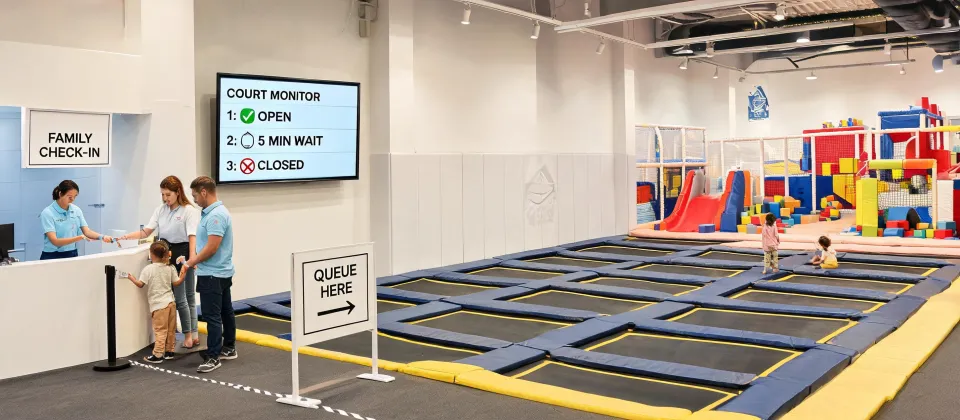
Ask the GM: 'How do you train new court monitors? Can I see the training checklist?' If they hand you a one-page sheet with five bullet points, that's a bad sign. Good training should include hands-on drills, a written test, and a shadow shift. I've seen parks where the training was literally 'watch a video and you're good'—that's how injuries happen.
Also ask about ongoing safety meetings. Do they have weekly huddles? Do they track near-misses? The best parks I've audited have a whiteboard in the back office with 'Incidents This Month: 0.' That culture starts at the top.
Step 4: Check the Arcade and Party Room Quality
For a Sky Zone, the arcade and party packages are major revenue drivers (especially for toB clients booking corporate events or birthday parties). Walk through the arcade with a critical eye:
- Are all games working? A broken game in a corner that's been 'out of order' for weeks tells you about maintenance priorities.
- Are the ticket redemption prices reasonable? Overpriced prizes frustrate customers.
- Is the party room clean and well-stocked with tables, chairs, and a cake fridge?
I once visited a location where the party room smelled like old pizza and the fridge wasn't working. The franchisee told me 'that's not my job.' That's a red flag for any investor. Small details like this affect Google reviews—and if you're considering buying a franchise, those reviews matter for your future ROI.
Step 5: Review the Local Marketing and Competitive Landscape
Even the best park can struggle if the local marketing is weak. Ask to see their monthly marketing report. How do they promote sky zone trampoline park columbus tickets? Do they run Google Ads? Are they active on social media?
Also, scope out nearby competitors. For example, if there's an escape room in Columbus Ohio (like escape room columbus ohio), that's a different demographic, but it still competes for discretionary entertainment dollars. A good franchise should have a strategy for positioning against alternatives, not just other trampoline parks.
One thing that surprises people: I often get asked who buys used gym equipment near me. It sounds unrelated, but franchisees who exit sometimes sell their equipment. If the current owner has already listed their trampoline mats or arcade machines on secondary markets, that could mean they're planning to close. Ask about equipment lifecycle management.
Bonus: Why Small Investors Shouldn't Be Scared Off
I've worked with franchisees who started with a single small park and now own three. The vendors who treated their first order seriously—even when it was just a test run—are the ones they still use for $2 million builds. Sky Zone's franchise model is designed to support operators from small markets to regional hubs. Don't let anyone tell you that a smaller venue isn't worth their time.
That said, my experience is based on reviewing about 60+ family entertainment centers. If you're looking at a mega-complex with 50,000 square feet and a full laser tag arena, the calculus might be different. Your mileage may vary if the local demographics are unusual—say, a college town vs. a suburban family area.
Common Mistakes to Avoid
- Skipping the background check on the franchisor's support team: Ask for references from three franchisees who opened in the last two years. Not the ones they pick—the ones you find on your own.
- Over-relying on national brand recognition: Sky Zone is a strong brand, but local execution is everything. A poorly run park hurts the whole chain.
- Ignoring the contract fine print: I've seen royalty fee structures that change after year two. Get a lawyer who understands franchising.
Last thing: I want to say the inspection template we use comes from years of trial and error. But don't quote me on the exact number of audits—I might be misremembering. The point is: be thorough. Your investment deserves it.

Jane Smith
I’m Jane Smith, a senior content writer with over 15 years of experience in the packaging and printing industry. I specialize in writing about the latest trends, technologies, and best practices in packaging design, sustainability, and printing techniques. My goal is to help businesses understand complex printing processes and design solutions that enhance both product packaging and brand visibility.
Leave a Reply