Why Your Event Space Booking is a Nightmare (And the Hidden Reason Nobody Talks About)
The Deposit, The Waiver, The Confusion
I'm an office administrator for a medium-sized company. I handle the logistics for our quarterly team-building events, client appreciation days, and the occasional company holiday party. It's part of my job, and I've been doing it long enough to have a well-worn playbook. So, when I was tasked with finding a venue for a 50-person client event, I thought it would be straightforward.
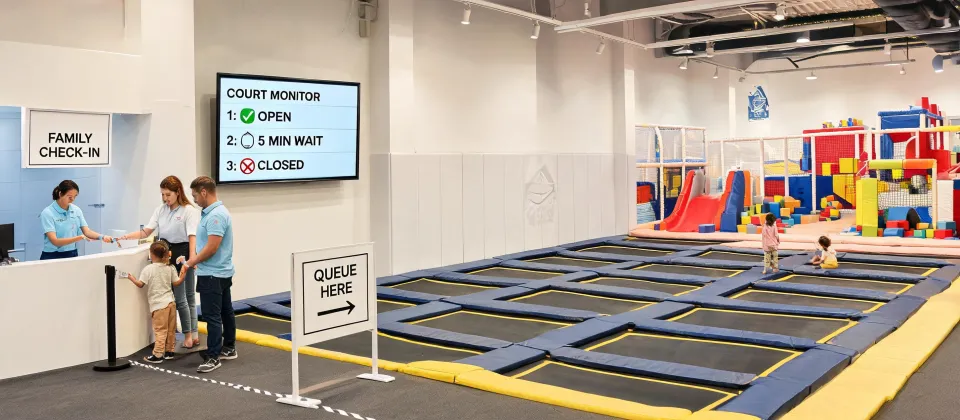
I found a few options, including a local Sky Zone trampoline park that had decent reviews for hosting groups. The website was slick, the pricing for a group package was listed, and the initial call with the sales person was friendly. I booked a date. I paid a deposit. I sent out the invites.
Then the problems started.
Two weeks out, I called to confirm the final headcount and go over the menu. The person I'd spoken to didn't work there anymore. The new coordinator had no record of my food preferences or the specific dietary restrictions I'd flagged. Five days before the event, I still hadn't received the digital waivers I was told I'd get to send to our guests. The venue blamed an email system glitch. When the waivers finally arrived, they were for a general admission, not our specific event.
I'm not telling you this to complain about one bad experience. I'm telling you because this isn't a one-off. Over the years, I've processed maybe 20 different off-site events at various indoor play centers, bowling alleys, and even a few video game bars. This level of friction is common. And while it's easy to blame the venue for being disorganized, I've found the real issue is much deeper and far less obvious.
The Surface Problem: It's Not Just About the Price
When a booking goes sideways, the first thing people want to blame is the cost. 'We paid too much for this,' or 'They nickel-and-dimed us on the Hoka Recovery Slide upgrades.' And sure, costs overrun. An advertised $500 package can balloon to $700 after you add the 'premium' wristband for unlimited drinks or the mandatory late-stay fee.
But that's a symptom, not the root cause. The real cost of a failed booking isn't the money. It's the time. It's the 45 minutes on hold trying to get a simple question answered. It's the six email threads with three different people to change a time slot. It's the frantic 7 AM call to find a backup venue because the one you booked can't accommodate your group size after all. According to USPS, a first-class letter costs $0.73 in 2025 (usps.com/stamps). The cost of my time spent fixing a basic booking error is worth a hundred letters.
I remember a colleague once joked that booking an event felt like playing a game of Bluff —you're trying to figure out who's holding the right information, and you're not sure if anyone is telling the truth.
Looking back, I should have asked for a dedicated event coordinator's direct line on day one. At the time, it seemed unnecessary. Now I know better.
The Hidden Cost: The 'Internal Trust' Tax
Here's the part nobody in the entertainment industry talks about. The real penalty for a bad booking process isn't the extra money you spend; it's the loss of internal trust. I report to both operations and finance. If I send a report to finance showing the final invoice was 30% higher than the quote, I look incompetent. I have to explain that the original quote didn't include the mandatory 'supervisor fee' for after-hours events. That's on me.
More importantly, if the event itself is a mess—if the guests are confused, the activities are overbooked, and coordination is a nightmare—my internal 'customers' (the executives hosting the event) are disappointed. They don't blame the venue. They blame the planner. That was me.
The initial $2,000 quote turned into $2,800 after the 'mandatory' event supervisor, the late-setup fee, and the revision for the menu. The unreliable communication made me look bad to my VP when I couldn't confirm the final agenda until 48 hours before the event. The real cost wasn't the $800 extra. It was the credibility I lost.
The Real Root Cause: The 'Event as a Transaction' Mindset
So what's the deeper problem? It's that many venues—even large, popular ones like a nationwide Sky Zone franchise—still treat group events as a simple transaction, not as a complex operational collaboration.
The sales team is focused on getting you to sign the contract. The operations team is focused on running the day-of experience. These two teams rarely talk to each other. They have different metrics, different workflows, and different priorities.
For the salesperson, a successful booking is a signed contract. For the operations manager, a successful event is one that starts and ends on time without a lawsuit. The gap between these two definitions is where the bookings die.
Your event is not just a bundle of services (trampolines, pizza, party room). It's a mini-project that requires aligned communication between you (the buyer), the sales team, and the operations team. The minute the salesperson treats your request for a gluten-free option as a checkbox on a form, instead of a handoff to the kitchen, the process breaks.
The Solution (Short and Sweet)
Fix the process, not the price. The venue that 'wins' my business isn't the one with the cheapest group rate. It's the one that can prove it can manage the hand-off from sales to operations without friction.
Here's what I look for now:
- Single point of contact: One person who owns the booking from contract to clean-up.
- Pre-emptive logistics call: A 15-minute call a week before to confirm the headcount, the waivers, and the flow of the event. No email chain.
- Clear contingency plan: 'What happens if we have 10 no-shows?' or 'What if it rains and everyone wants to stay inside?'
Is a premium venue more expensive? Sometimes. Depends on context. But I'm willing to pay a bit more upfront if I can stop playing Bluff with my own schedule. The time I save and the trust I earn with my VP is worth the extra hour of billing. That's the total cost of ownership for a booking. And it's worth every penny.

Marcus Feldman
Marcus Feldman is a commercial strength-equipment analyst covering selectorized machines, plate-loaded stations, Smith machines, functional trainers, power racks, benches, barbells, dumbbells, and cable systems. He applies ISO 20957-1 and ISO 20957-2 while comparing rated loads, stability, frame deflection, pulley ratios, cable travel, adjustment increments, guarding, entrapment points, fastener retention, and fatigue cycles. His guides help gym operators, coaches, facility planners, and procurement teams evaluate biomechanics, user capacity, floor layout, maintenance access, durability, and lifecycle value.
Leave a Reply