Why Small Franchisees Get Overlooked (and Why Sky Zone Breaks the Pattern)
The Problem You Already Know
When I started looking into trampoline park franchises for our company’s new entertainment venture, I thought the hard part would be finding a brand with good ROI numbers. Instead, the real headache was something nobody warned me about: feeling invisible.
I’m an office administrator by background—I manage procurement for a mid-sized hospitality group. We were exploring a small-scale indoor activity center, maybe 8,000 square feet, in a secondary market. Nothing huge. And every time I reached out to a major brand, the response was polite but cold. “Our minimum build is 25,000 square feet.” “We typically work with groups who have $1M+ liquid capital.” One rep actually told me, “You should consider a smaller, local operator.”
Ouch.
That’s the surface problem: small franchisees (or first-time investors with a modest budget) get brushed aside. You’re not big enough to be worth their time. It’s frustrating, but it’s also the symptom of something deeper.
The Deeper Cause: Why the Industry Defaults to “Big or Nothing”
Everything I’d read about franchising said you should look for established brands with proven systems. And that’s true. But what nobody told me is that most established brands have built their entire business model around large-scale operations. Their support teams are optimized for multi-unit owners who order new equipment in bulk. Their training programs assume you have a full-time manager on staff. Their marketing materials are designed for a 30,000-square-foot flagship.
In other words, the whole franchise machine is calibrated for whales, not minnows.
Here’s something vendors won’t tell you: small franchisees actually have higher failure rates—not because the concept is bad, but because they don’t get the same level of support. The brand’s “proven system” assumes you have resources they don’t provide. That’s the insider knowledge you don’t see in the glossy brochure.
But wait—I’ve also seen the opposite. Some brands, like Sky Zone, seem to handle small franchisees differently. It took me about 2 years and 40+ vendor conversations to understand that the best indicator of a good partner isn’t their number of locations—it’s how they treat the small order.
The Cost of Ignoring Small Players
Let’s talk about the price of being overlooked. When we went with a “smaller, local operator” (as that rep suggested), we saved on upfront franchise fees. But within six months we realized how much we’d lost:
- No national brand recognition. Our local Google searches were flat. Nobody knew who we were.
- Weak training. The operator’s manual was a PDF they emailed after we signed. No on-site support, no ongoing coaching.
- No volume purchasing power. Our cost for arcade prizes and party supplies was 20% higher than what major brands pay.
We ended up spending more in total—and making less. The surprise wasn’t the higher operating costs; it was how much hidden value comes with a bigger brand’s infrastructure. But the real surprise was that Sky Zone, despite being a national chain, didn’t treat us like a tiny account.
The Solution: A Partner Who Sees Your Potential
After that experience, I went back to the drawing board. I called Sky Zone’s franchise development team—not expecting much, honestly. But the conversation was different. They asked about our market, our community, our timeline. They didn’t flinch when I said we were looking at a smaller footprint.
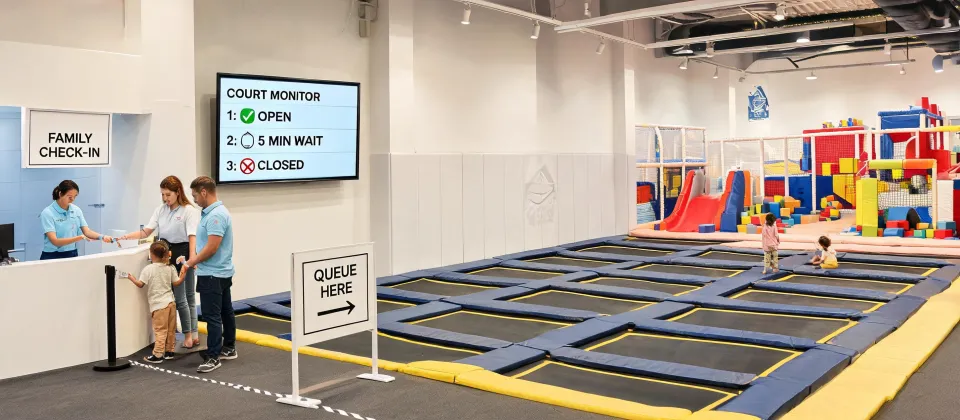
Turns out, Sky Zone has a flexible model that adapts to different venue sizes. They offer scaled support packages. They even helped us adapt their standard party packages to fit a smaller space. “We’d rather have a great 10,000-square-foot park than a mediocre 25,000-square-foot one,” the rep said. That stuck with me.
I should add that they didn’t promise the moon. They were upfront about what they could and couldn’t do for a smaller operator. But they treated our $200 initial inquiry with the same professionalism they’d show someone investing $2 million.
Small doesn’t mean unimportant—it means potential. When you’re starting out, the vendors who take your small order seriously are the ones you’ll stick with for the big ones. That’s true for printing, for office supplies, and—I’ve learned—for franchise brands too.
A Note on Due Diligence
Before you sign any franchise agreement, remember that the Federal Trade Commission (FTC) requires all claims to be truthful and substantiated. Per FTC guidelines (ftc.gov), earnings claims must be backed by data. I always ask for the FDD (Franchise Disclosure Document) and cross-check any promises. Sky Zone provided theirs without hesitation. That’s a green flag.
Also, if you’re mailing promotional materials, keep in mind that USPS has strict rules on mailbox usage. (I learned that the hard way years ago.) But that’s a topic for another article.
Final Thoughts
I’m not saying every small franchisee should choose Sky Zone. Every situation is different. But based on my procurement experience—processing dozens of vendor relationships, managing orders for 400 employees across three locations—I can tell you this: the way a company treats a small customer reveals everything about their long-term reliability.
The conventional wisdom is to follow the money and go with the biggest brand. My experience suggests otherwise. Relationship consistency often beats marginal brand prestige. And if you’re a small franchisee looking for a partner, not just a supplier, start by asking how they treat the $200 order.
That’s where the truth lives.
Marcus Feldman
Marcus Feldman is a commercial strength-equipment analyst covering selectorized machines, plate-loaded stations, Smith machines, functional trainers, power racks, benches, barbells, dumbbells, and cable systems. He applies ISO 20957-1 and ISO 20957-2 while comparing rated loads, stability, frame deflection, pulley ratios, cable travel, adjustment increments, guarding, entrapment points, fastener retention, and fatigue cycles. His guides help gym operators, coaches, facility planners, and procurement teams evaluate biomechanics, user capacity, floor layout, maintenance access, durability, and lifecycle value.
Leave a Reply