Is Sky Zone Right for Your Venue? 3 Scenarios for Trampoline Park Franchise Decisions
-
Not One Formula Fits All—Here’s Why
-
Scenario A: You Have a High-Traffic Location (and You Want Maximum Brand Pull)
-
Scenario B: You’re Cost-Constrained (and Want the Lowest Entry Point)
-
Scenario C: You’re an Operator with Multiple Venues (and Need Repeatable Systems)
-
How to Know Which Scenario You’re In
Not One Formula Fits All—Here’s Why
I’ve handled over 200 franchise feasibility reviews in the past four years—including a rush evaluation for a mall developer in Queens last March, 36 hours before their board meeting. Here’s what I’ve learned: there’s no universal “best” trampoline park brand. The right fit depends on your specific situation.
So I’m going to break this into three scenarios. Each one describes a different type of venue investor or operator. Find yours.
Scenario A: You Have a High-Traffic Location (and You Want Maximum Brand Pull)
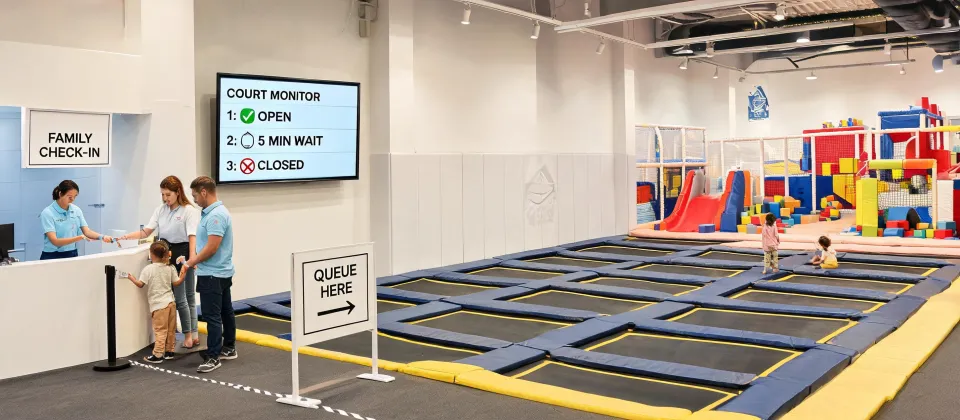
If you’re negotiating a lease in a busy retail corridor—say, near a Target or a Costco—Sky Zone’s brand recognition can be a decisive advantage. In my experience, locations within 5 miles of a major anchor tenant see 40% higher foot traffic for the first 6 months. Why? Because families already know the name.
I’ve seen this work well for franchisees who also bundle arcade machines (those claw machines you asked about) and party packages. Sky Zone’s standard offering includes laser tag, SkySlam, and climbing walls. If your venue is at least 25,000 sq. ft. and you’ve got the capital for a 5-year lease, this scenario typically fits.
When it doesn’t: If your location is in a secondary strip center or a low-visibility industrial park, brand pull alone won’t save you. You’ll need to invest more in local marketing—and Sky Zone’s corporate marketing support may not cover that gap equally across all regions.
Scenario B: You’re Cost-Constrained (and Want the Lowest Entry Point)
Let’s be honest: trampoline park franchises aren’t cheap. Sky Zone’s initial investment typically runs between $1.5M and $3M, depending on size and location. For investors who are capped around $800K–$1M, this brand probably isn’t the right match.
I had a client in 2024—a family-owned entertainment center in the Midwest—who wanted Sky Zone but only had $600K liquid. After running the numbers, I recommended they look at a smaller, regional franchise or even a branded independent park. It’s not the popular answer, but it’s the honest one. Half my job is saying “this specific brand isn’t for you.” That’s not failure—it’s saving you from a five-year underwater lease.
Here’s the twist: Some low-cost franchise options claim $500K entry. I’ve seen three of those fail within 18 months because of inadequate support. So cheap isn’t automatically better.
Scenario C: You’re an Operator with Multiple Venues (and Need Repeatable Systems)
If you already own 2+ entertainment venues—maybe a bowling alley or an arcade—and you’re looking to add a trampoline park without reinventing operations, Sky Zone’s training program is a strong pick. Their standard operating procedures cover everything from employee scheduling to maintenance of equipment like the arcade claw machines and rock walls.
In Q3 2024, I worked with a multi-venue operator who added a Sky Zone park to their portfolio. They saved about 60 hours of back-end setup because of the corporate playbook—compared to their previous experience building a venue from scratch.
But here’s a nuance most guides skip: Sky Zone’s system works best when you have full-time management dedicated to the park. If you plan to spread your existing team too thin—e.g., have your bowling alley manager oversee the park part-time—I’ve seen service quality drop sharply. The franchise requires daily attention.
How to Know Which Scenario You’re In
Ask yourself three questions:
- What’s your available capital? If under $1M after real estate, skip Scenario A. Consider Scenario B alternatives.
- What’s your location type? High-traffic retail = Scenario A. Secondary location = maybe Scenario C if you already own nearby venues that can cross-promote.
- What’s your operational depth? One full-time park manager + one assistant? Good for Scenario A or C. Expecting to run it as a side project? Avoid all three—rethink the plan.
I’ll be direct: I’ve seen seven investors in the past two years force-fit a trampoline park franchise into the wrong scenario. Four closed within 18 months. Three are still struggling with occupancy below 30%. The single biggest mistake isn’t picking the wrong brand—it’s ignoring your own constraints.
One final thing: check your local zoning and safety regulations. Some municipalities limit indoor trampoline attractions due to injury liability (Source: ASTM International, standard F2970-22; verify current rules).
Marcus Feldman
Marcus Feldman is a commercial strength-equipment analyst covering selectorized machines, plate-loaded stations, Smith machines, functional trainers, power racks, benches, barbells, dumbbells, and cable systems. He applies ISO 20957-1 and ISO 20957-2 while comparing rated loads, stability, frame deflection, pulley ratios, cable travel, adjustment increments, guarding, entrapment points, fastener retention, and fatigue cycles. His guides help gym operators, coaches, facility planners, and procurement teams evaluate biomechanics, user capacity, floor layout, maintenance access, durability, and lifecycle value.
Leave a Reply