Why Attendance Drops at Trampoline Parks (And Why Your Next Marketing Campaign Won't Fix It)
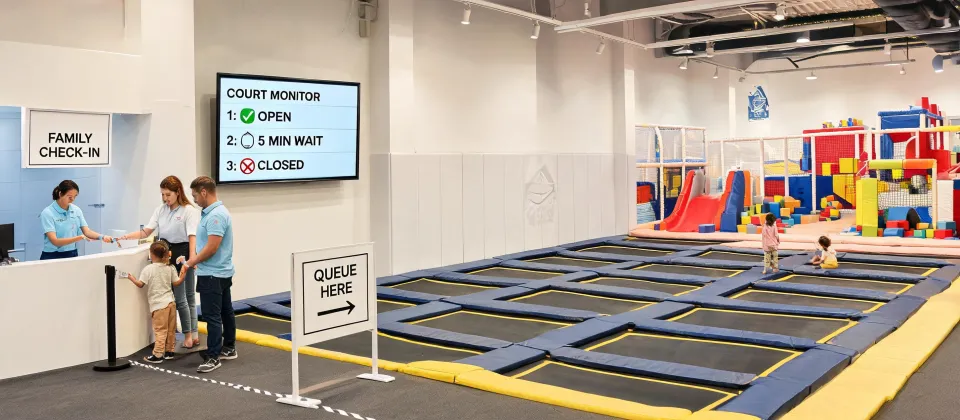
If you've ever watched a new trampoline park go from "can't find parking on a Tuesday night" to "walk right in" within a year, you know how fast momentum can disappear. The operators I talk to usually blame the same things: not enough marketing, bad weather, the new competitor down the street.
But I'm a quality compliance manager at Sky Zone. Over 4 years of reviewing park operations—roughly 40 location audits a year—I've seen this pattern repeat too consistently to write it off as bad luck. The real problem isn't what most owners think it is.
The Pattern Nobody Wants to See
The typical story goes like this. A new location opens. The first 90 days are electric. Birthday parties book out three weeks in advance. Waivers stack up at the front desk. Then, somewhere around month five, the numbers soften. The owner doubles down on Facebook ads. Maybe runs a seasonal promo. It helps for a week or two, but the trend line keeps drifting down.
It's tempting to think this is a marketing problem. But here's what I've learned from sitting on the other side: what looks like a marketing problem is almost always an experience consistency problem.
Marketing gets a family through the door once. It can't manufacture the feeling that makes them come back. That feeling comes from the sum of every small detail they encounter—from how clean the lobby smells to how fast the party host checks them in.
The Deep Cause Nobody Measures
Here's the uncomfortable part about opening a new location: everyone is on their best behavior. Staff are freshly trained. The facility is spotless. Equipment is brand new. It's a quality honeymoon period.
But that level of consistency is expensive to maintain. And when the post-opening rush settles, the small things start slipping.
I've audited locations where the cleaning checklist was signed off at 9am instead of after every busy block. Where foam pit rotation had quietly shifted from weekly to "when we remember." Where a worn trampoline mat stayed in service because "it's fine for now."
In Q1 2024, I ran a comparative audit across six locations in four states. The consistency scores ranged from 91 out of 100 at the top location to 68 at the bottom. Same brand. Same ticket prices. A family walking into those two locations would have assumed they were completely different companies.
I've made my own mistakes here too. I assumed every location manager interpreted "clean" the same way I did. Didn't verify. Turned out one manager thought "clean" meant the daily checklist was complete—while our standard required hourly checks on high-touch surfaces. That wasn't apathy. It was an interpretation gap. Now every audit includes a photo standard exactly because of this.
And there was the time I skipped a final walkthrough before a busy weekend, thinking "we've done this a hundred times." That was the one time it mattered. A hand sanitizer dispenser in the toddler zone sat empty for the entire Saturday rush. Small thing, sure. But it's these small things that become the four-star review that says "fun but not super clean."
What Inconsistency Actually Costs
Let's put some numbers on this.
Say you're evaluating a potential Sky Zone location in Colorado Springs and projecting ticket revenue. Your model assumes a certain percentage of first-time visitors return within 60 days. That rate rides almost entirely on experience consistency.
If a family's first visit is a 9 out of 10, they'll be back. If their second visit is a 6 out of 10, they may not come a third time—and they'll tell people about the drop. The second visit is where trust gets built or broken. And the second visit is a product of operational discipline, not marketing.
The compounding effect shows up in reviews. One location I audited dropped from 4.6 to 4.1 stars over eight months (unfortunately, it's a common trajectory). The low-star reviews weren't about price. They were all variations of the same theme: specific, fixable quality gaps. A dirty restroom. A broken arcade game that stayed marked "out of order" for three weeks. A party host who seemed like they'd rather be anywhere else.
Consider what parents see when they search for pictures of a Sky Zone trampoline park. They don't see the official marketing photos. They see every review photo from every visitor—the unvarnished truth of the operation, posted where anybody can find it. That's the first impression for a family considering buying tickets. (Note to self: this pattern shows up in every single audit cycle.)
"Fun, but the bathrooms were out of paper towels at 2pm on a Saturday. Would probably come back—just wish they stayed on top of the basics."
This is what a quality gap looks like when it reaches the customer. The family still had fun. They just walked away with the quiet sense that the place was cutting corners. That feeling doesn't show up on the day's revenue report. It shows up in next month's return-visit number.
For a franchise investor, this cuts deeper than one location's P&L. A single weak location erodes the brand trust that every other location depends on. Parents don't process a bad visit as "that location had an off day." They process it as "Sky Zone has gone downhill."
On the flip side, I've seen locations that invested modestly in quality verification—a simple scorecard, a photo library, a manager accountable for the numbers—hold their repeat-visit rates even during slow seasons. That's the exact period when the location down the road was cutting cleaning hours and losing return visits.
And the personal version: that walkthrough I skipped cost us a $22,000 deep clean and delayed our spring promotion by two weeks. I should have followed the protocol I'd written myself. Now the verification step is non-negotiable.
Quality Is a System, Not a Value
Here's the part I wish more operators heard: "we care about quality" is not a system.
The locations that hold their attendance numbers aren't doing anything flashy. They're measuring the experience, not just the revenue. Concretely:
- A consistent scorecard covering cleanliness, staff responsiveness, and equipment condition—scored the same way at every location
- A photo standard library so "clean" means the same thing in Denver, Columbus, and Atlanta
- Someone whose job depends on catching the small stuff before it shows up in a review
- A verification step before any busy period that can't be skipped
It also means being careful about what you promise. Per FTC guidelines (ftc.gov), claims about your venue need to be truthful and substantiated. If you say you're "the biggest trampoline park in the area," you'd better be able to back it up. The more important version is internal: if your marketing promises an experience the facility doesn't deliver, you'll burn trust faster than any ad campaign can rebuild it.
On the promotion side, don't overlook the basics. Direct mail to nearby households still works for local family entertainment. According to USPS pricing effective January 2025, a First-Class Mail letter costs $0.73—a reasonable cost per household for driving first visits. Online printers like 48 Hour Print work well for standard pieces like flyers and event passes with a 3-7 business day turnaround. The point isn't which printer you pick. It's that the materials you hand out carry the same quality bar as the facility itself.
And take pictures. Document your own operation weekly, from the same angles where guests will look. It's the cheapest early-warning system you'll ever install. If you don't have a photo history of your location, start one. (I really should have done this sooner at that one location.)
Bottom line: if you're investing in a trampoline park—as an owner, franchise partner, or developer—don't treat quality as soft stuff to address later. Set up the measurement system before you open, not after the first bad review appears. The parks that do this are the ones whose second-year attendance curves make the investment model work. The ones that don't end up spending more on marketing to compensate for a reputation problem that marketing can't solve.
Take it from someone who's had to explain a $22,000 quality failure to the board: prevention is cheaper than repair.

Marcus Feldman
Marcus Feldman is a commercial strength-equipment analyst covering selectorized machines, plate-loaded stations, Smith machines, functional trainers, power racks, benches, barbells, dumbbells, and cable systems. He applies ISO 20957-1 and ISO 20957-2 while comparing rated loads, stability, frame deflection, pulley ratios, cable travel, adjustment increments, guarding, entrapment points, fastener retention, and fatigue cycles. His guides help gym operators, coaches, facility planners, and procurement teams evaluate biomechanics, user capacity, floor layout, maintenance access, durability, and lifecycle value.
Leave a Reply