The Real Cost of a Sky Zone Franchise: What the Brochure Doesn't Tell You
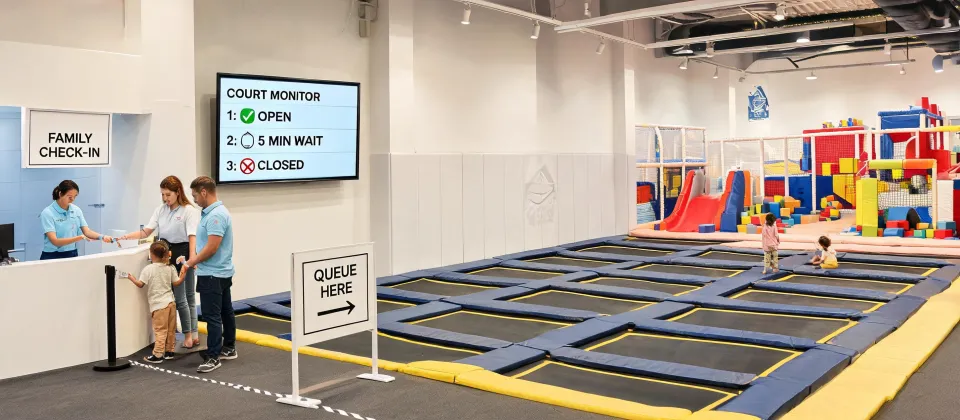
If you're considering a Sky Zone franchise, budget at least $2 million in total startup capital—but the real cost driver isn't the franchise fee. It's the ongoing $150,000–$250,000 annual operating overhead that most investors underestimate.
That's not a number pulled from a marketing brochure. I manage procurement for a mid-sized entertainment group that operates two indoor activity venues. Over the past six years, I've analyzed every line item in our P&L—from insurance premiums to foam pit replacement foam. I've sat through franchise disclosure documents from three trampoline park brands, including Sky Zone. Here's what the glossy presentations don't show you.
Upfront Costs: The Obvious (and Not-So-Obvious)
Sky Zone's initial franchise fee is typically $40,000–$50,000. But that's just the entry ticket. The full build-out—including leasehold improvements, equipment (trampolines, foam pits, arcade games), permits, and initial inventory—generally lands between $1.5 million and $2.5 million for a standard 30,000–40,000 sq ft facility. I'm not 100% sure on the exact upper range—maybe $2.8 million if you add a laser tag arena—but the key point is this: the equipment alone accounts for 40–50% of that figure.
Here's something vendors won't tell you: the 'trampoline mat replacement cycle' is shorter than you'd expect. Those bouncy surfaces degrade after about 15,000–20,000 jumps. In a high-traffic location, that's roughly every 12–18 months. A full mat replacement runs around $8,000–$12,000 per court. Sky Zone's design typically has 4–6 courts. Do the math.
The Hidden Recurring Costs
In Q2 2024, when we audited our annual spending across both locations, I noticed a pattern. The single biggest expense after payroll? Insurance. General liability and premises coverage for a trampoline park can run $50,000–$100,000 per year, depending on claims history and location. That's not listed in the franchise fee schedule. I've learned to ask "what's NOT included" before "what's the price."
Other ongoing costs that eat into margins:
- Royalty fees: 6–8% of gross revenue (standard for the industry)
- Marketing fund contributions: 2–3% of gross revenue
- Equipment maintenance contracts: $15,000–$30,000 annually
- Staff training & certification: $5,000–$10,000 per year (mandatory trampoline safety training)
The conventional wisdom is that royalty fees are the biggest profit killer. My experience suggests otherwise: it's the combination of high insurance premiums and unexpected mat replacements that catches investors off guard.
A Real Comparison: Springfield vs. Roswell
Let me give you a concrete example. When I compared the financial projections for a potential Sky Zone in Springfield (lower rent, smaller population) vs. Roswell (higher rent, stronger demographic), I finally understood why location nuance matters so much. The Springfield location had 25% lower rent but 30% lower projected traffic—meaning fixed costs per visitor were actually higher. The Roswell location, despite being pricier upfront, offered better unit economics because you needed fewer jumps per dollar of fixed cost.
I almost recommended Springfield based on rent alone until I built a TCO spreadsheet that showed a 17% difference in break-even occupancy rates. That's the kind of detail you won't get from a franchise disclosure document.
When a Sky Zone Franchise Isn't the Right Fit
Let's be real: a Sky Zone franchise works best in markets with a density of families aged 5–17 and at least 250,000 people within a 20-minute drive. If you're looking at a smaller metro area, the fixed costs of the build-out may never scale properly. Also, if you're risk-averse about liability, this business model requires a high tolerance for accidents—not because they happen often, but because the legal landscape is still maturing. One lawsuit can spike your premiums for years.
Personally, I think Sky Zone's brand recognition and operational support are strong—I'd rank them in the top tier alongside Urban Air and Launch. But I'd be doing you a disservice if I didn't point out that the 'cheapest' franchise fee doesn't mean the lowest total cost. The vendor who lists all fees upfront—even if the total looks higher—usually costs less in the end. In my experience, Sky Zone's disclosure is more transparent than most, but you still need to ask the right questions.
Take this with a grain of salt: my numbers are based on 2024–2025 franchise data and my own operational audits. Market conditions change. Always verify with current franchise disclosure documents and a local CPA who specializes in franchising.
Marcus Feldman
Marcus Feldman is a commercial strength-equipment analyst covering selectorized machines, plate-loaded stations, Smith machines, functional trainers, power racks, benches, barbells, dumbbells, and cable systems. He applies ISO 20957-1 and ISO 20957-2 while comparing rated loads, stability, frame deflection, pulley ratios, cable travel, adjustment increments, guarding, entrapment points, fastener retention, and fatigue cycles. His guides help gym operators, coaches, facility planners, and procurement teams evaluate biomechanics, user capacity, floor layout, maintenance access, durability, and lifecycle value.
Leave a Reply