The Franchisee's 4-Point Quality Check: What I Inspect Before Signing a Sky Zone Deal
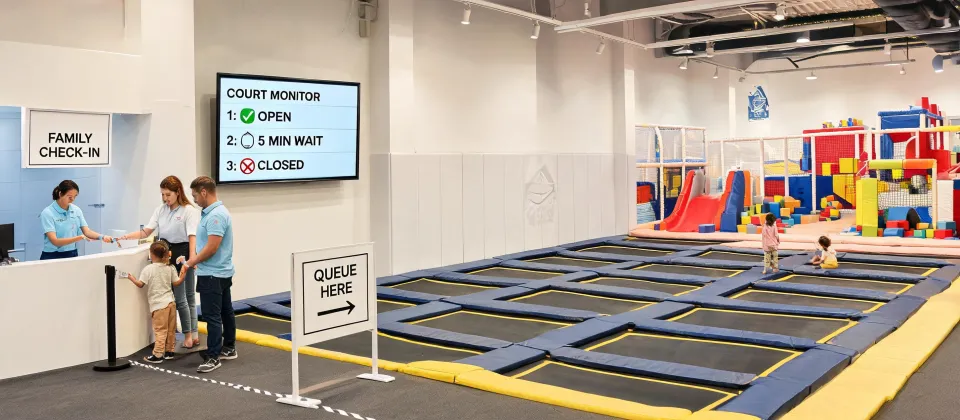
Who This Checklist Is For
If you're evaluating a Sky Zone franchise—or any indoor entertainment investment—you're probably comparing initial franchise fees, royalty percentages, and build-out costs. That's where I started too, five years ago.
I manage quality compliance for a mid-sized entertainment group. We've reviewed 40+ franchise opportunities in the family entertainment space over the last three years. I've rejected proposals from three different brands in Q1 2025 alone because the real costs didn't surface until we dug past the brochure numbers.
This checklist isn't about whether Sky Zone is a good brand—it's about whether a specific Sky Zone deal is good for you. Four checkpoints. That's it. Miss one, and the total cost of ownership shifts dramatically.
Checkpoint 1: The "Hidden" Construction & Equipment Line Items
When I first started reviewing franchise disclosure documents, I assumed the build-out estimate covered everything. It doesn't. Here's what I now check before comparing any two locations:
- Base build-out cost — The number in the FDD. Record it.
- Site preparation — Land grading, utility runs, parking lot resurfacing. One of our rejected deals had a $120,000 site prep line that wasn't in the initial estimate.
- Equipment delivery & installation — Trampoline courts arrive on flatbeds. Installation crews cost per hour. (Should mention: we once had a two-week delay because the crew wasn't scheduled until after the floor was poured.)
- Arcade game purchasing & placement — Sky Zone parks typically include redemption games. New machines cost $8,000–$15,000 each. Used machines save upfront but carry higher maintenance costs. I want to say we budget $12,000 per game on average, but don't quote me on exact numbers—prices shift with market demand.
- Contingency — 10% minimum. If the developer says construction never goes over, they're selling, not consulting.
Total cost thinking here: The $500,000 build-out estimate might feel reasonable. Add site prep, equipment, and a realistic contingency, and you're at $680,000. That extra $180,000 isn't a surprise—it's a predictable line item if you know where to look.
Checkpoint 2: The Real Revenue Drivers (Not Just Admission)
Standard franchise models show revenue from admissions, memberships, and parties. What's harder to verify is the mix—and that mix drives your actual return.
I used to think the party package revenue was the margin driver. It is, but only if your local market actually books parties at the projected rate. Three years ago, we modeled a new location assuming 40% capacity for birthday parties on weekends. After 18 months, we were at 28%. The revenue projection was off by $60,000 annually.
What I now check:
- Historical party booking rates for comparable locations (not just system-wide averages)
- Arcade and redemption revenue — This is where the margin lives. Games don't require staff to run. If the location's arcade mix is weak, the profitability per square foot drops.
- Off-peak utilization — What happens Tuesday at 2 PM? If the model assumes 30% capacity for "open jump" but your local demographics are families with school-age kids, that number needs adjusting.
Total cost thinking here: An over-optimistic revenue projection doesn't just lower your return—it increases your risk cost. You'll carry debt longer, need more working capital, and potentially hit royalty payments earlier than cash flow supports.
Checkpoint 3: The Operations Support Reality
Sky Zone's brand-level support is well-documented. What varies is the local execution. This is where I've seen the biggest gap between promise and delivery.
Don't get me wrong—the training materials are solid. I reviewed their ops manual as part of our due diligence in 2024. The issue isn't content; it's consistency of application.
What to verify:
- Field support frequency — How often does a brand representative visit? Quarterly, or only when there's a problem? (Should mention: one operator told me they saw a rep twice in year one, both times for compliance audits.)
- Marketing co-op effectiveness — National brand awareness helps. But local marketing support from the corporate team varies. Ask for specific examples of co-op campaigns in markets like yours.
- Supply chain reliability — Replacement parts for trampoline surfaces, safety nets, and arcade equipment. How long does a standard order take? We had a three-week lead time for a custom safety net once. Not ideal when your main attraction is down.
Total cost thinking here: Weaker local support means more of your time spent managing operations. Your time has a cost. If you're spending 10 hours a week compensating for support gaps, that's effectively a hidden expense.
Checkpoint 4: The Exit & Transfer Terms
Most franchise agreements are 10–15 years. You don't plan to exit on day one, but the terms of a potential exit affect your total cost of ownership from day one.
Looking back, I should have paid more attention to the transfer and resale provisions in our first deal. At the time, I assumed we'd hold for the full term. We didn't—circumstances changed—and the transfer fee and restrictions reduced our exit proceeds by roughly 15%.
Check:
- Transfer fee — Often a percentage of the sale price. Can be 5–10%.
- Right of first refusal — The franchisor may have the right to buy back the location at a formula-based price, not market value.
- Non-compete radius — If you sell and want to open a different entertainment concept nearby, how restrictive is the non-compete?
Total cost thinking here: A deal that looks profitable over 10 years might carry a 15% exit cost. On a $1.5M location, that's $225,000. Factor that into your total cost analysis from the start.
Common Mistakes I See Franchisees Make
Mistake 1: Treating the franchise fee as a sunk cost. It is, but it's also the price of access to systems, brand, and support. Compare it against the cost of building a similar concept independently. For Sky Zone, the brand awareness and ops systems are valuable—but only if you actually use them.
Mistake 2: Assuming all locations cost the same to build. We reviewed two Sky Zone locations in the same state. One cost $420,000 to build; the other $580,000. The difference? Site prep, local permit fees, and equipment choices. The FDD gives a range—your actual cost depends on your specific site.
Mistake 3: Underestimating ongoing equipment maintenance. Trampoline parks require regular safety inspections and surface replacement. Arcade games break. If you haven't budgeted 3–5% of gross revenue annually for maintenance and replacement, you're underestimating the operational cost.
Mistake 4: Over-reliance on projected revenue from the franchisor. The model is based on system-wide averages. Your local demographic, competition, and seasonal patterns will differ. Build your own projection using local data.
Mistake 5: Ignoring the cost of your own time. If you're an active operator, your time has an opportunity cost. If you're a passive investor, factor in management fees. The 'cheapest' deal, in terms of upfront cash, can be the most expensive when you account for your time commitment.
Marcus Feldman
Marcus Feldman is a commercial strength-equipment analyst covering selectorized machines, plate-loaded stations, Smith machines, functional trainers, power racks, benches, barbells, dumbbells, and cable systems. He applies ISO 20957-1 and ISO 20957-2 while comparing rated loads, stability, frame deflection, pulley ratios, cable travel, adjustment increments, guarding, entrapment points, fastener retention, and fatigue cycles. His guides help gym operators, coaches, facility planners, and procurement teams evaluate biomechanics, user capacity, floor layout, maintenance access, durability, and lifecycle value.
Leave a Reply