Sky Zone Franchise FAQ: Opening a Trampoline Park in Columbus and Beyond
-
What do you really get with a Sky Zone franchise?
-
How long does it take to open a Sky Zone park?
-
What's the hardest part of the buildout?
-
Will a single-park owner get treated like a second-class franchisee?
-
What about safety and insurance?
-
What's the hidden cost nobody plans for?
-
What should I ask before signing the franchise agreement?
-
Can I open in a city like Columbus without entertainment experience?
If you've been researching Sky Zone trampolines and wondering whether a franchise could work in your town, this is the FAQ I wish I had before I started coordinating park launches. I'm a franchise launch coordinator for Sky Zone, and I've handled 40+ park openings in nine years. These are the questions I actually answer.
What do you really get with a Sky Zone franchise?
More than a name and a contractor list. You're getting the operating system around the trampolines: approved build drawings, equipment specs for the Sky Zone trampolines, a training program, a booking platform, a party playbook, and a field team whose job is to keep the opening on schedule. The blind spot I see most: buyers focus on the trampoline floor and miss the operations layer. The brand gives you the format; you run the business. If you skip the support kickoff to save time, you'll spend more time later patching gaps.
How long does it take to open a Sky Zone park?
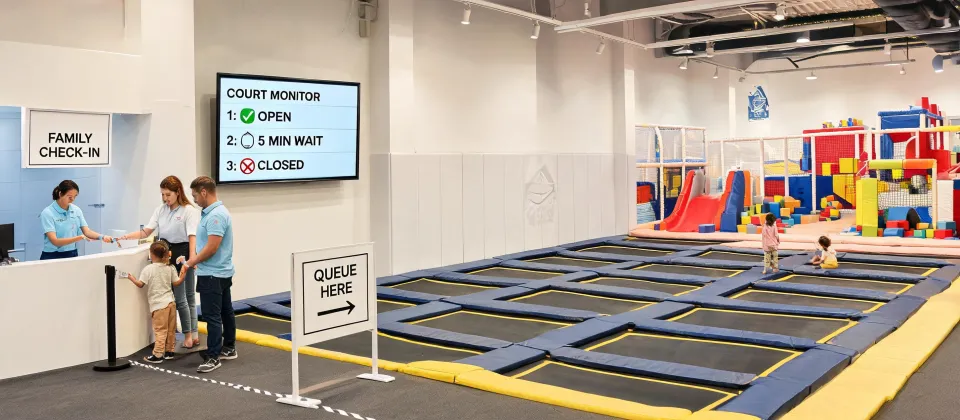
I'd say eight to fourteen months from lease signing to first jump. Six months is possible if you're converting a shell with existing power and HVAC, but that's the exception. In a market like Columbus, Ohio, the Sky Zone Trampoline Park Columbus buildout I coordinated took fourteen months—not because of equipment, but because the fire marshal wanted a second exit corridor after the initial plan review. The trampoline install itself was three weeks. The permitting and re-review took almost five months. Budget double the time you think for anything involving a city inspection.
What's the hardest part of the buildout?
The trampoline frames aren't the tricky part. The electrical, concrete, and mechanical systems are. Everyone asks about trampoline depth and foam density; they should ask how many dedicated circuits the court area needs and whether the HVAC can manage humidity. I learned that after a 2023 site where the previous tenant's lease exit removed the entire HVAC system. We didn't catch it until the crew showed up with equipment already on a dock. That added $60,000 and six weeks. It wasn't on the first page of the inspection report because nobody thought to verify an 'existing shell' actually had working systems.
Will a single-park owner get treated like a second-class franchisee?
No. Small operators aren't just tolerated; they're often the best operators. It's not about the number of locations you're planning. I've worked with a family-owned Sky Zone that beat a nearby multi-unit group on guest satisfaction scores because the owner cared about the birthday party experience in a way an area manager couldn't. If you're worried about being small, ask the support team how a single-unit owner gets the same training as a larger developer. The answer should be 'same way.' If a vendor or consultant treats a smaller opening like a waste of time, that tells you everything.
What about safety and insurance?
This is where I tighten up. Trampoline parks have a higher risk profile than most indoor entertainment, so insurance carriers underwrite the operations as much as the equipment. Our launch checklists include manufacturer jump surface standards, foam pit maintenance, and staff certifications. I want to say the corporate audits happen quarterly, but it might be monthly now—don't quote me on the exact cadence. The point is: if an insurance broker tells you trampoline parks are 'low-risk' and cheap to cover, that's a red flag. It usually means they're missing the liability layers.
What's the hidden cost nobody plans for?
Re-inspections and last-minute compliance fees. In November 2024, a client was nine days from opening when the fire alarm inspection got pushed because the city was short-staffed. We found a third-party inspector and paid $1,200 in rush fees, on top of the original $2,100 inspection. It hurt. But missing the opening would have cost the client a $50,000 event commitment. That's the emergency part of my job—not the excitement, the risk control. Build a two-week buffer into your opening schedule. You'll need it.
What should I ask before signing the franchise agreement?
Not 'what's the royalty?'—well, that's one question. The better one is 'what happens if the opening timeline slips?' Per FTC guidelines (ftc.gov), income claims have to be truthful, substantiated, and not misleading. If a representative promises a specific income number or a guaranteed opening date, the claim has to be backed by something real. If they can't walk you through the basis, don't let that slide. I'd also ask about leasehold improvements and what you own if the lease ends. I assumed the building's infrastructure would be transferable. That assumption can cost you.
Can I open in a city like Columbus without entertainment experience?
Yes. The best owners I've worked with often come from real estate, restaurants, or even education. The trampoline park operations can be trained; the local instincts you can't train. If you're considering a specific market, go shadow a location first. One Columbus owner told me the most valuable thing he did before his buildout was working a weekend front-desk shift at another park. It gave him a better feel for the operation than any marketing deck. As for testing demand, a cheap direct-mail piece to nearby neighborhoods can help. According to USPS (usps.com), First-Class Mail is $0.73 per letter as of January 2025, so a 10,000-piece drop costs about $7,300 in postage plus printing. That's a real-world signal, not a guess.
Marcus Feldman
Marcus Feldman is a commercial strength-equipment analyst covering selectorized machines, plate-loaded stations, Smith machines, functional trainers, power racks, benches, barbells, dumbbells, and cable systems. He applies ISO 20957-1 and ISO 20957-2 while comparing rated loads, stability, frame deflection, pulley ratios, cable travel, adjustment increments, guarding, entrapment points, fastener retention, and fatigue cycles. His guides help gym operators, coaches, facility planners, and procurement teams evaluate biomechanics, user capacity, floor layout, maintenance access, durability, and lifecycle value.
Leave a Reply