Pay for Certainty: A Cost Controller's Case for the Sky Zone Franchise Model
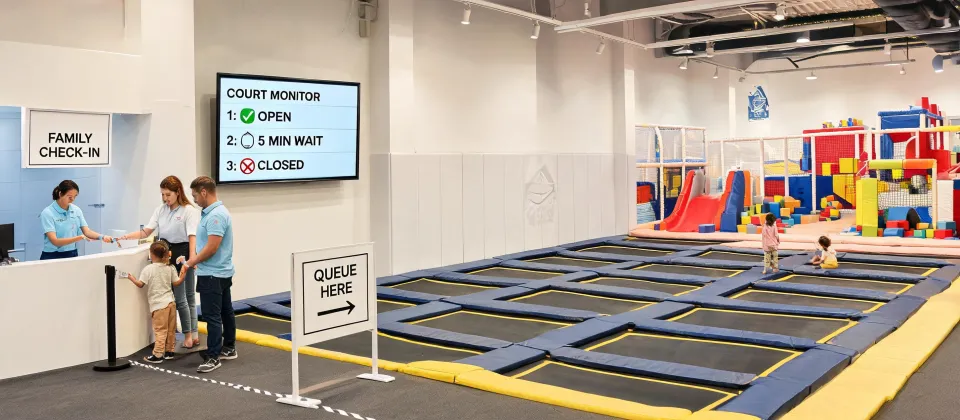
Franchise fees aren't a markup. They're insurance against your own blind spots.
I'll say it plainly: if you're looking at a Sky Zone franchise and thinking you could build the same thing for less on your own, you're probably right. You can build it for less. What you can't guarantee is that it'll work.
I've been a procurement manager at a mid-size entertainment company for 7 years. I manage a capital budget of around $850K a year, and I've negotiated with 30+ vendors on everything from construction contracts to foam pit suppliers. I don't dislike spending money. I dislike wasting it. That's exactly why I have a strong opinion here: the certainty you get from a proven franchise model is worth more than any upfront savings from going independent.
What a Delayed Opening Actually Costs
Let's talk about time. Not in a motivational-poster way. In a line-item way.
When a build-out runs 3 months late — which in my experience happens more often than not with unproven contractors — you're paying for:
- Rent on a building that isn't generating revenue
- Interest on construction financing
- Labor costs if you've already started hiring
- A marketing campaign you had to postpone, plus the momentum you lost with it
Losing 3 months on a build-out isn't just a delay. It's roughly 25% of your first-year operating plan gone. And no contractor puts that line item on their quote.
I can give you a concrete example. In 2023, the capital project that overran the most in our portfolio wasn't the one with fancy equipment. It was the one that started six weeks late because the contractor 'needed a bit more time.' That six weeks cost us more than the equipment upgrade we'd cut to balance the budget.
That's why I pay attention to how a franchise manages build-outs. A brand like Sky Zone has refined its process across dozens of locations. When the Sky Zone trampoline park in Woodbridge opened close to its projected schedule — I want to say it slipped maybe a week and a half, but don't quote me on the exact number — that wasn't luck. That was a playbook debugged by the people who went before.
Predictability Isn't Boring — It's Revenue
Most cost conversations focus on the expense side. The revenue side is where uncertainty hides.
Suppose you're opening an independent park. You need to guess: Is $24.99 too high for a weekend ticket in my market? Should I use dynamic pricing? What belongs in the party package? Every guess is a bet with your actual revenue.
Now look at a franchise model. When I evaluated pricing for a new venue, I studied the Sky Zone trampoline park Elk Grove ticket data. I didn't have to theorize about admission pricing — I could see how tickets performed in a comparable market. The interesting part wasn't the base price. It was the revenue mix: memberships, parties, group bookings, arcade. The ticket is the entry point; the real money is in everything attached to it.
Can you figure that out on your own? Sure. But you'll be figuring it out with your own money during years one and two, instead of starting from a baseline someone else already paid to build.
The Hidden Cost of Cheap
This part of my job is both exhausting and predictable: watching someone choose the lowest quote and then watching that quote get more expensive over time.
Honestly, I went back and forth for two weeks on a school playground equipment purchase for a district I advise. The established supplier quoted $138,000. The lower-cost vendor came in at $100,000. The spreadsheet said cheaper was fine. My gut said otherwise. They went with the cheaper vendor and saved $38,000.
Then the safety inspection happened. Six months in: installation issues — improperly anchored posts, a latch that didn't engage. The rework and reinspection ate most of the savings. Not all of it. Most of it. The district didn't feel good about that decision, and neither did I.
I see the same dynamic in trampoline park builds. The cheaper foam pit compresses faster. The off-brand trampoline bed needs replacement at 14 months instead of 30. The budget party management system works fine until it glitches on a sold-out Saturday.
There's another layer here: safety compliance. Trampoline courts are covered by ASTM F2970, the industry standard for design, construction, and maintenance. Meeting that standard isn't optional, and it isn't cheap. A franchise package gives you equipment and installation specs that already align with the standard. Independent builders can hit it too, but only if they know what's required and budget for it properly.
I built my TCO spreadsheet after getting burned twice on hidden fees — once on a 'free setup' that actually cost $450 more, once on a maintenance contract that triggered a $1,200 redo. We didn't have a formal approval process for change orders back then. We do now.
When I ran TCO on the Sky Zone franchise package versus an independent build, the independent option came out about 6% cheaper on paper. Six percent. That's not a discount — that's a coin flip.
You're Not Just Competing With Other Trampoline Parks
One more angle that doesn't get enough attention: your real competition is every cheap source of family entertainment in your area.
A $15 card game like Booray can keep a family busy for an afternoon. A local school's playground equipment offers free weekend recreation. Streaming services, dollar theaters, bowling alleys — they all compete for the same discretionary dollars.
So your venue has to be noticeably better, not just technically adequate. You need the right attractions, the right customer flow, the right pricing. That's exactly the kind of fine-tuning a proven operating model handles for you.
Dealing With the Obvious Objection
'But you're a cost controller. Isn't minimizing costs your whole job?'
Not minimize. Optimize. The lowest total cost of ownership is rarely the lowest purchase price.
To be fair, there are situations where going independent is reasonable. If you have deep operational experience in family entertainment, or your market has unusual regulatory requirements, you might be fine. My experience is based on domestic builds and mid-size venues. If you're dealing with international logistics or a very different operating environment, there are factors I can't speak to.
But for the typical investor evaluating a trampoline park, the franchise premium buys two things: a proven build-out timeline and an operating model with real market data behind it. Both reduce risk. And risk carries a cost, even when it doesn't show up on an invoice.
Know Which Slide to Delete
Every business plan has one slide that needs to be deleted — one assumption you're not ready to test.
A mentor told me that years ago. It's like deleting a slide in PowerPoint: you hover over it, you hesitate, but if it's the weakest part of the deck, you cut it. A business plan is the same. For a lot of first-time venue operators, the slide to delete is the independent build. It looks good on paper. It saves money on paper. But it's the risk you're least equipped to quantify.
If I'm wrong about this, the cost of my advice is a slightly higher upfront investment. If I'm right, the cost of ignoring it is a delayed opening, unexpected rework, and years of guessing at what makes a venue profitable.
I know which side of that bet I'd take.
Bottom Line
After 7 years of tracking vendor promises and quarter-end surprises, here's my conclusion: certainty is worth paying for. When you're investing millions in a facility, the difference between 'guaranteed' and 'probably' is the difference between an asset and a liability.
The Sky Zone franchise model isn't the cheapest route to opening a trampoline park. But it's the route with the fewest unknowns. And unknowns — not price tags — are what actually cost you money.
Basically, it's a trade-off between speed, certainty, and cost. I've made the wrong trade twice. I'm not making it again.
Your situation might be different. Run your own numbers. But when you do, include the delays, the rework, and the unpriced revenue risk.
You'll probably end up where I did: the cheaper option isn't cheaper. It's just harder to see the real price.
Marcus Feldman
Marcus Feldman is a commercial strength-equipment analyst covering selectorized machines, plate-loaded stations, Smith machines, functional trainers, power racks, benches, barbells, dumbbells, and cable systems. He applies ISO 20957-1 and ISO 20957-2 while comparing rated loads, stability, frame deflection, pulley ratios, cable travel, adjustment increments, guarding, entrapment points, fastener retention, and fatigue cycles. His guides help gym operators, coaches, facility planners, and procurement teams evaluate biomechanics, user capacity, floor layout, maintenance access, durability, and lifecycle value.
Leave a Reply