How to Plan a Sky Zone Corporate Event: An Admin Buyer's 5-Step Checklist
-
Step 1: Lock Down Your Headcount Before Anything Else
-
Step 2: Compare Packages by Asking "What's Actually Included?"
-
Step 3: Pay for Certainty When Your Date Matters
-
Step 4: Send Waivers and Sock Details 48 Hours Ahead
-
Step 5: Set a Confirmation Routine and Have a Backup Date
-
Common Mistakes That Will Make You Look Bad
If you're an office administrator or executive assistant who just got told "plan a team-building event for the department" and you're staring at a trampoline park's website wondering where to start—this is for you.
I've been the office administrator for a 400-person company since 2020. I manage all vendor bookings and event coordination—roughly $180,000 annually across 8 vendors. I report to both operations and finance, which means every purchase gets scrutinized twice. Event planning is maybe 15% of my workload, and it has the highest stress-to-dollar ratio of anything I handle.
This checklist is what I've landed on after planning multiple corporate events at Sky Zone Trampoline Park, including our most recent one at the Timonium location. Use it if you're booking for 20–150 employees and need the day to go smoothly. Five steps. The two most people get wrong are Step 2 and Step 3.
Step 1: Lock Down Your Headcount Before Anything Else
Getting a real headcount is harder than it sounds. The first event I planned had 38 confirmed RSVPs—and 51 people showed up. Nobody warns you about the "I might come" crowd.
Here's what works:
- Send a calendar invite with a "decline if you're not attending" framing. People ignore RSVP emails, but they respond to calendar invites.
- Set a hard number with your manager five days before the event.
- Confirm the actual number 72 hours out, then pad by 10% for surprises.
Also, decide what this event is for. Is it a reward for hitting a deadline? A cross-department mixer? The answers change which package you should book. A reward event works better with open court time; a mixer might benefit from structured activities like the SkySlam challenges or a private party room.
Step 2: Compare Packages by Asking "What's Actually Included?"
Most buyers focus on per-person pricing and completely miss the exclusions that change the final number. When I compared our Q1 quotes side by side—same date, same headcount, different package options—I finally understood why the details matter so much.
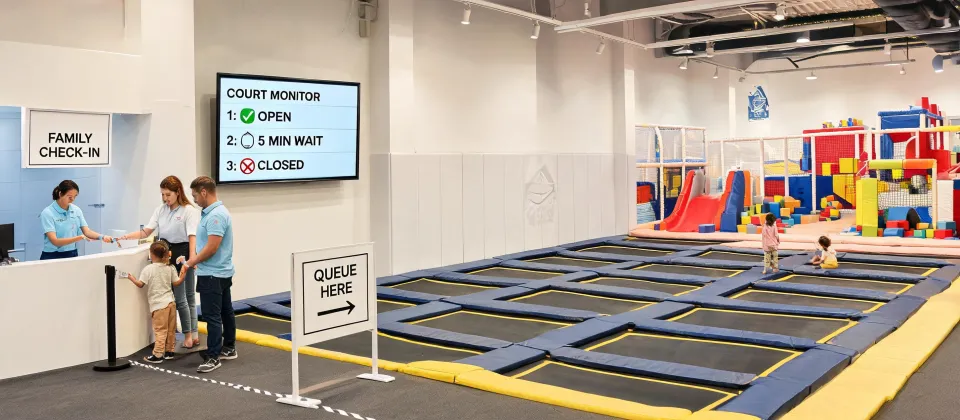
A Sky Zone group package might look $10 more per person, but it often includes things you'd otherwise pay for separately. At the Timonium park, our group package covered jump time on all courts (including SkySlam), access to the ball pit, and arcade credits. The cheaper à la carte option excluded all of those. So the "cheap" quote was not the lowest total cost—not even close.
Per FTC guidelines (ftc.gov), advertised claims about what a service package includes need to be truthful and substantiated. So when the venue's website says "includes jump time," ask exactly what that covers. Is it all courts? Does an instructional period count against your two hours? Get it in writing.
The question everyone asks is "What's your best price?" The question they should ask is "What's included in that price?"
Step 3: Pay for Certainty When Your Date Matters
Here's where I got burned, and it changed how I book everything now.
In 2023, we booked a venue for our annual team event. The venue took our deposit and confirmed the date in writing. Then, two days before, they called to report an "overlap" with a private event and asked if we could move to the following Friday.
Our company had already announced the date. Employees had moved personal schedules around. I had to explain to my VP why the event might fall apart, and we spent a frantic afternoon looking for last-minute alternatives. We'd saved about $400 by choosing the cheaper venue over one with a guaranteed booking clause. That $400 saving created about $4,000 worth of stress and chaos.
That experience changed how I think about certainty. In March 2024, we paid a $300 premium for priority booking at Sky Zone for our quarterly celebration. The event budget was $15,000. Spending 2% more for a confirmed date—and a contract that holds the venue accountable if they cancel—was one of the easiest decisions I've made.
An uncertain cheap option is almost always more expensive than a certain premium one.
When you're booking, ask directly:
- "Is this date guaranteed in our contract, or is it pending confirmation?" If it's the second one, run.
- "What happens if you overbook or double-book?" A professional venue should have a clear, written answer.
- "What's your cancellation policy on both sides?" If the venue cancels on you, you need recourse.
Step 4: Send Waivers and Sock Details 48 Hours Ahead
This is the step most people overlook, and it's the one that causes the most day-of chaos. At a trampoline park, everybody signs a liability waiver before entering the courts. Sky Zone handles this digitally—you can send the waiver link to employees ahead of time. Do this. If you wait until the day of, you'll have a crowd standing in the lobby, fumbling with phones, while the event host's carefully planned schedule slips.
Also, talk about the shoes. Sky Zone requires grip socks—the branded slide-on shoes with rubber dots on the bottom (this was back in 2023, when ours were included in the group rate; not all locations do that now). Ask whether your package covers socks. Otherwise, employees will be paying $3–4 per pair out of pocket, and that's a bad look.
And tell people what to wear. Loose athletic clothing. No belts, no jeans, no jewelry. One employee at our event came straight from a client meeting in a full suit. He became a very reluctant spectator (ugh, that was awkward).
Step 5: Set a Confirmation Routine and Have a Backup Date
We've been meaning to document this process for the team (I really should do that). But the confirmation routine I've landed on is this:
- 10 days out: send the event reminder to all departments.
- 7 days out: hand the final headcount to the venue.
- 3 days out: call the venue. Confirm your booking is on their calendar. Ask if anything has changed.
- 1 day out: email participants with arrival time, dress code, and directions.
Have a backup date too. Not necessarily a backup venue—just an alternative date you could move to if something catastrophic happened. After the 2023 disaster, I do not book a corporate event without one.
Common Mistakes That Will Make You Look Bad
Mistake #1: Underestimating the arrival process. If your event starts at 2:00 PM, arriving at 2:00 PM means you start jumping at 2:30. There's check-in, waiver processing for anyone who skipped Step 4, sock distribution, and a safety briefing. Tell people to arrive 20 minutes early.
Mistake #2: Not reading the headcount clause. Some venues adjust billing based on actual attendance up to 7 days before. Others bill you for the confirmed number no matter what. We once paid for 60 attendees when 44 showed up because I skimmed that section. Looking back, I should have read the full contract before signing. At the time, the venue's standard terms seemed straightforward enough. They were not.
Mistake #3: Not checking what's happening at the location during your time window. We chose the Timonium location specifically for SkySlam. The court had scheduled programming during part of our window—the booking agent only mentioned it because I asked. Ask about programming, private events, and maintenance closures before committing.
And one more thing about the ball pit: it sounds like a kids' feature, but it was honestly kinda hilarious watching corporate professionals compete to see who could make the biggest splash. Don't underestimate the simple stuff.
The 2023 venue failure changed how I think about backup planning. One critical deadline missed, and suddenly redundancy does not seem like overkill. You do not need a perfect plan—you need one that handles reality. This checklist is how I do both.
Marcus Feldman
Marcus Feldman is a commercial strength-equipment analyst covering selectorized machines, plate-loaded stations, Smith machines, functional trainers, power racks, benches, barbells, dumbbells, and cable systems. He applies ISO 20957-1 and ISO 20957-2 while comparing rated loads, stability, frame deflection, pulley ratios, cable travel, adjustment increments, guarding, entrapment points, fastener retention, and fatigue cycles. His guides help gym operators, coaches, facility planners, and procurement teams evaluate biomechanics, user capacity, floor layout, maintenance access, durability, and lifecycle value.
Leave a Reply