How to Book a Venue for a Corporate Event (Without the Headaches)
How to Book a Venue for a Corporate Event (Without the Headaches)
Okay, let's be real. If you're in charge of booking a venue for a company event, you've probably already felt that knot in your stomach. I manage purchasing for a 400-person company, and I can't tell you how many times I've seen a perfectly planned event fall apart because of one overlooked detail.
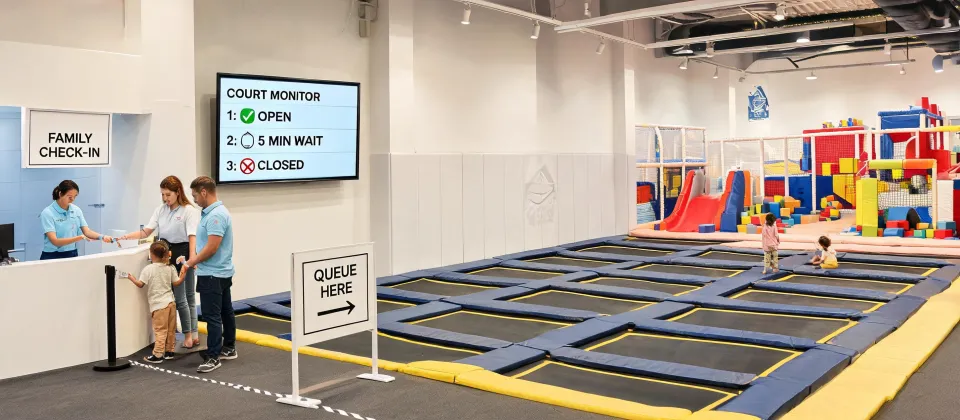
I'm not a professional event planner, so I can't speak to the creative design aspects. But from a procurement and operations perspective, I've learned a few things the hard way. This checklist is meant for admin buyers like me who need to book a unique venue—like an indoor trampoline park—for a corporate function, and want to avoid the common pitfalls.
Here are the 5 steps I use now for every venue booking. Follow them, and you'll save yourself a lot of trouble.
Step 1: Align on the 'Why' Before the 'Where'
This is the step most people skip. Don't.
Before you even look at a venue, you need to know exactly what the event is for. Is it a team-building day to boost morale? A client appreciation party? A quarterly all-hands meeting? The 'why' changes everything.
For example, if the goal is simple team bonding, a venue like Sky Zone with its trampolines and laser tag can be fantastic. But if the goal is to have a serious, sit-down presentation, you're going to need a different setup entirely.
Checklist for this step:
- Define the primary goal of the event.
- Identify the expected number of attendees.
- Confirm the budget range.
- Get sign-off from your manager on these three points.
Step 2: Verify the Venue's Core Capabilities
This is where you get into the nitty-gritty. Don't just look at the pretty photos online. I learned this the hard way in 2023 when I booked a 'modern loft' space that looked amazing in pictures but had a sound system so bad nobody could hear the speaker.
When considering a venue like a trampoline park, here's what you need to confirm:
- Private vs. Public Space: Can you truly have a private area for your group, or will you be mixed in with the general public? For a corporate event, you almost always want a private space.
- Catering & Food Options: Do they have an on-site kitchen? Can they accommodate dietary restrictions? What's the per-person cost?
- A/V Capabilities: Need a microphone? A projector for a slide show? Make sure the venue has it and that it works. Trust me, don't assume.
- Safety & Insurance: This is a big one, especially for active venues. Ask for a copy of their liability insurance. Your company's legal team will thank you.
Pro tip: Ask for a site visit. Seeing the space in person is way more valuable than any virtual tour.
Step 3: Understand the Pricing Model Completely
This is where things get tricky. A quoted price is rarely the final price.
Most venues have a base rental fee. But then come the add-ons. I remember one time I was quoted a great price for a venue, only to find out later that the price didn't include tables, chairs, or linens. That added $1,200 to the final bill.
Here's what you need to ask for in writing:
- Base Rental Fee: What does this include? (e.g., space, basic staffing, setup/cleanup).
- Per-Person Costs: Is it a flat rate, or does it change based on attendance?
- Add-Ons: Food and beverage minimums, A/V equipment fees, security deposits, cleaning fees.
- Payment Terms: Deposit required? Final payment due date? Late payment penalties?
- Cancellation Policy: This is critical. What happens if you need to cancel 30 days out? 14 days out? 48 hours out?
Get the full pricing breakdown in a formal proposal. Don't rely on verbal promises.
Step 4: Schedule a Pre-Event Walkthrough and Timeline
This is a step I didn't use to do, but now it's non-negotiable.
About two weeks before the event, schedule a walkthrough with the venue's event coordinator. This isn't just a casual visit. You're going to walk through the entire event timeline.
Walk through these points:
- Arrival & Check-in: Where do guests enter? Where do they check in? Will there be signage?
- Flow of the Event: If people are moving between activities (e.g., trampolines, to food, to presentations), is the flow logical?
- Staffing: How many venue staff members will be on-site? Who is the main point of contact for you on the day of the event?
- Load-In/Load-Out: If you have any outside vendors (like a DJ or a cake delivery), where do they enter and what are the time constraints?
This walkthrough alone has saved me from at least a dozen disasters.
Step 5: Confirm the Final Contract and Invoicing
This is the part where my admin buyer brain kicks in. I will never forget the vendor in 2020 who couldn't provide a proper invoice. They sent a handwritten receipt. Finance rejected the expense report instantly. I ended up eating $400 out of my department budget. Never again.
Before you sign anything, confirm the following:
- The contract is final: Read every line. Make sure the date, time, number of guests, and pricing match the proposal.
- Invoice format: Ask if they can provide a digital invoice (PDF) with their Tax ID. Most professional venues can, but it's better to check.
- Payment method: Do they accept company credit cards, or do they require a check or ACH?
Getting the invoice right the first time saves you a ton of hassle with your accounting team. I've processed over 60 orders annually for the last 5 years, and this is the most common mistake I see people make.
Final Thoughts and Common Mistakes
Even with this checklist, things can go wrong. Here are the most common mistakes I've seen—and made:
- Waiting too long to book: The best venues get booked months in advance, especially for weekends. Start your search at least 3-4 months out for larger groups.
- Not having a backup plan: What happens if the A/V system breaks? Or if it rains and part of the event was outdoors? Always have a Plan B.
- Forgetting about parking: Can your 100 attendees find parking easily? Is it free? This seems small, but it can ruin the guest experience.
Per USPS pricing effective January 2025, the cost of mailing invitations for a 100-person event has gone up. But that's a small concern compared to the potential for a bad venue booking.
Honestly, this whole process isn't rocket science. It's about being organized, asking the right questions, and learning from your mistakes. Use this checklist, and you'll be way ahead of the game.

Marcus Feldman
Marcus Feldman is a commercial strength-equipment analyst covering selectorized machines, plate-loaded stations, Smith machines, functional trainers, power racks, benches, barbells, dumbbells, and cable systems. He applies ISO 20957-1 and ISO 20957-2 while comparing rated loads, stability, frame deflection, pulley ratios, cable travel, adjustment increments, guarding, entrapment points, fastener retention, and fatigue cycles. His guides help gym operators, coaches, facility planners, and procurement teams evaluate biomechanics, user capacity, floor layout, maintenance access, durability, and lifecycle value.
Leave a Reply