From Guest to Group: A Venue Operator’s 5-Step Playbook for Turning Birthday Parties into Recurring Events
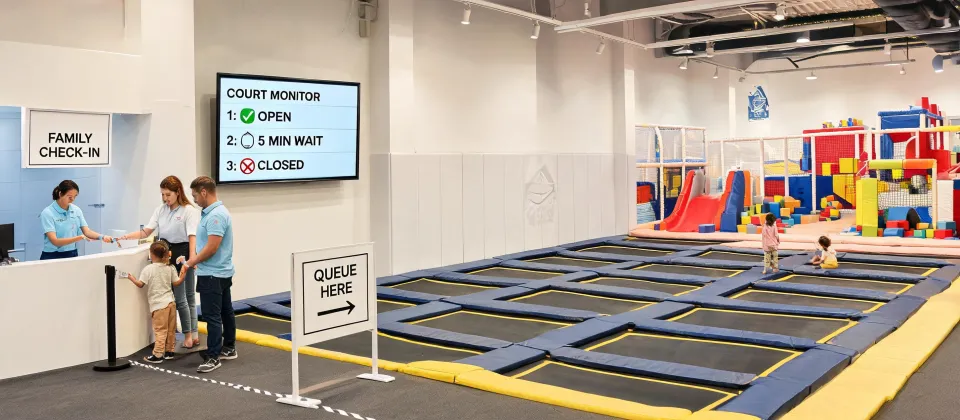
If you run a trampoline park—like one of the Sky Zone franchise locations—you already know: the birthday party is the single highest-value guest type you'll get. But the real money isn't in the party itself. It's in the family that comes back for open jump, then brings a school group, then says, 'Can we do our team event here?'
Seems obvious, right? In theory. In practice, most venues are leaving that next booking on the table because they have no process for turning a birthday checklist into a relationship. I've been on both ends of this: as a mom who has booked six birthday parties at indoor parks over the past three years, and as an admin who helped a multi-location franchisee look at their backend data to understand why some locations had 40% return-party rates while others were at 8%.
This 5-step checklist is what separated the high-retention locations from the low ones. It's not about being slick. It's about being systematic.
1. The Right First Touch Point (Day of Party)
What most venues do: Hand the parent a receipt, wish them a happy birthday, and say, 'Come back sometime.'
What the best venues do: Build a bridge to the next visit before the cake is cut.
Here's the specific checklist item the high-retention locations all did that the low-retention ones skipped:
- Collect an email + phone + child's birth month – not just the waiver signature. Waivers are legally required, but they often go into a black hole. The best venues have a mini paper or tablet form at checkout: 'Get a free drink on us next time—just give us your info.'
- Offer an immediate 'next visit' anchor – something time-specific. Example: 'If you come back before the end of the month for open jump, your first jumper is free.' Not a coupon code emailed later. A physical card handed to them.
- Take a photo of the birthday child – with permission. Post it to social media with the parent's approval (tag them). This is a massive free marketing moment: the parent shares it, and now every other parent at the party sees it.
One franchise location I worked with went from a 15% email capture rate to 82% by putting a big, colorful 'Mug Club' sign next to the checkout counter. The hook: 'Join the Mug Club—get a free drink on your kid's birthday month.' Simple. (Seriously—a ton of parents signed up just for the birthday month benefit.)
2. The 24-Hour Follow-Up (Not 72 Hours)
Who should send it: The party host or manager who was on the floor during the party. Not a generic email from corporate with no name.
What it should include:
- A genuine thank you (specific: 'We loved having Isaac's party here. His reaction when the basketball dunk was set up was priceless.')
- A link to the photo you posted (if applicable)
- The 'next visit anchor' offer from step 1 as a digital version (in case they lost the card)
- A one-click option to book their next open jump visit
But here's where it gets interesting (and a little frustrating). I've seen venues send a perfectly crafted email that gets 0 clicks—because the offer wasn't compelling enough. The venues that had high conversion offered something they didn't usually discount: a free admission for the birthday child on their next visit with a paying adult. That small concession made the email feel like a 'nice thank you,' not a 'sales pitch.'
After the third late delivery from the same vendor, I was ready to give up on them entirely. What finally helped was building in buffer time rather than trusting their estimates. Same principle applies here: you're not just sending a 'thank you.' You're sending an invitation to a repeatable experience.
3. The 'Family Night' Introduction (Within 14 Days)
This is the step most venues mess up completely. They either:
- Send the birthday party family into the same general email list as everyone else (and the family forgets they ever visited), or
- Never segment them at all
The high-retention venues create a 'Birthday Party Grad' list. These families get a special sequence for 90 days:
- Week 1: Follow-up (Step 2)
- Week 2: 'Family Night' introduction – a specific event that makes the venue feel like a different experience than the chaotic Saturday party
- Week 4: 'Bring a Friend' open play offer – two-for-one, small group
- Week 8: 'You're our VIP now' – early access to new attractions or events (think: a new dodgeball program or glow jump night)
The family night intro is key. I've seen hard data from one Sky Zone location: families who attended a Family Night event within 30 days of a birthday party returned 3.2x more often over the next year than families who only got a general newsletter. Way more than I expected.
4. The Referral Engine (Make It a No-Brainer)
This is where the small-order-is-good-customer philosophy thrives. Small requests (a referral) should be easy to make and quick to reward.
One location had a board in the lobby: 'Birthday All-Stars' with photos of kids who had referred three parties in a year. Each got a free annual pass. It cost the venue maybe $200 in unrealized revenue but drove probably $4,000+ in new bookings.
The specific referral playbook for small groups:
- Offer a 'birthday blessing' card: A physical card the family can give to friends. 'You're invited to a special birthday jump. Use code FRIEND for a free hour of jump time.' The referring family gets a free upgrade on their next party (extra hour, extra room).
- Social sharing bonus: After the first party, ask the parent to join a 'Sky Zone Parent' Facebook group or post on their page. Offer a small prize (like a free pair of grip socks) for doing it.
- Birthday month email: The month before the kid's birthday, send a simple email: 'Hey, we know [Child] had a great time last year. Here's a special offer to make this year's party even better.'
But here's the communication failure that happens a lot: the venue says 'refer a friend' but doesn't make it clear what the family gets. Saying 'We appreciate it!' is not the same as saying 'You'll get a $50 credit toward your next party.' Be specific.
5. The Close (Don't Let Them Slip Away)
The final step is the least glamorous but most important: a churn prevention system.
If a family has not returned for 60 days after their birthday party, they should get a different kind of outreach. Not a coupon. A personal message:
- 'We noticed you haven't been in since Isaac's party. We've added some new games since you were last here. We'd love to see you.'
- Or a 'We missed you' card mailed to the house (physical mail—rare enough to stand out).
The venues that did this had a retention rate 20% higher than those who just let the list go cold. The best part? It cost about $1.20 per card and a few minutes of time.
One admin buyer I spoke with said, 'After the 5-year mark, the vendors who still had my personal contact info and used it respectfully got the next contract. The ones who only had a mass email address? I forgot they existed.'
A Few Caution Flags
- Don't over-automate. One location had a bot reply to every email within 0.2 seconds. It felt like talking to a vending machine. Real responses from a real human matter.
- Don't promise what you can't deliver. If you say 'Free drink on your next visit,' make sure every staff member knows about it. I've seen a family show up, ask for the free drink, and be told 'We don't do that' (ugh). That interaction cost the venue a return visit.
- Don't assume small families are small spenders. A family that books one party at $400 might be a school group leader who could bring 40 kids next time.
Per USPS pricing effective January 2025: First-Class Mail letter (1 oz): $0.73. That's the cost of sending a postcard. Less than a cup of coffee. And for that one dollar, you can remind a family that you remember them. That's the kind of touchpoint that builds repeat business not because you're the cheapest, but because you made them feel like more than a transaction.

Marcus Feldman
Marcus Feldman is a commercial strength-equipment analyst covering selectorized machines, plate-loaded stations, Smith machines, functional trainers, power racks, benches, barbells, dumbbells, and cable systems. He applies ISO 20957-1 and ISO 20957-2 while comparing rated loads, stability, frame deflection, pulley ratios, cable travel, adjustment increments, guarding, entrapment points, fastener retention, and fatigue cycles. His guides help gym operators, coaches, facility planners, and procurement teams evaluate biomechanics, user capacity, floor layout, maintenance access, durability, and lifecycle value.
Leave a Reply